Parallelhedra (Polyhedra with Parallelogram or Rhombus Faces)
This page documents my thought process and self-driven investigation behindd my pages on polyhedra and Zometool. It all started at a G4G conference at which I received a gift from the Zometool folks.
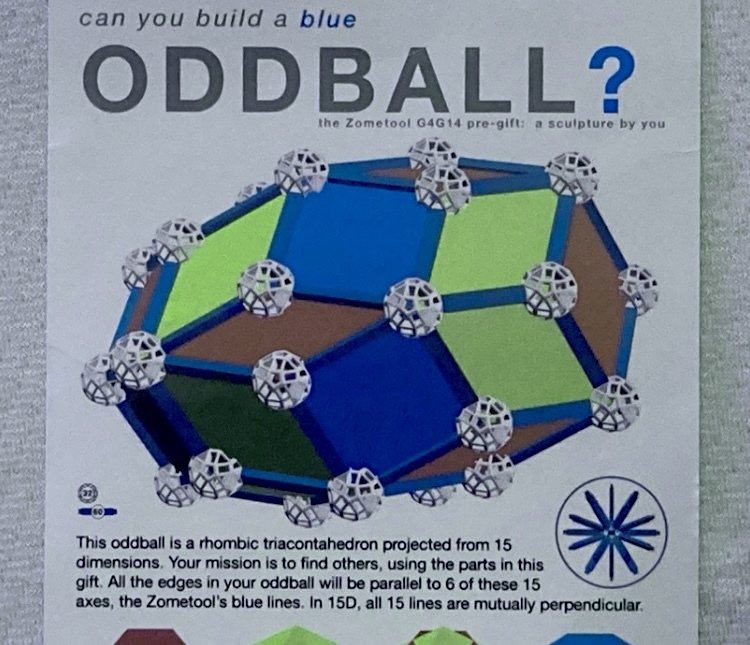
Can you build this?
As the text indicates, there were parts inside the "balls" for the vertices and the blue "struts" for edges) to build the polyhedron pictured — 32 vertices and 60 edges.
I started building just by following the picture (ignoring the specific instruction your mission is to find others) and noticed a few things:
- Since the faces are parallelograms (or more specifically rhombuses) I can often use what I've built so far as a guide to what to next.
- In addition to sharing the same direction, the edges in an "opposite pair" (opposite each other in any particular rhombus) also align with respect to the noncircular cross-section: the provided blue struts have a rectangular cross-section, giving a subtle difference in appearance. This cross-section aligns with the sockets in the ball connector, which helps to find the right socket (out of 62 choices).
- The rhombuses in the diagram are filled in different colours.
- The arrangement of rhombuses, as described in the text, is like that in the rhombic triacontahedron but are of different aspect ratios (some "wide", some "narrow", and some so wide that they're squares).
- The triacontahedron arrangement means that the vertices always have either 3 or 5 edges, and every edge joins a 3-vertex to a 5-vertex. I took advantage of this to help figure out the build (not noticing that the text also points it out).
Regarding the colours, I wondered if these were meant to convey information — perhaps useful for building, or for understanding the structure I was building. I first guessed that the colours correspond to different orientations (parallel planes), with yellow if it is parallel to one of the faces on an icosahedron, blue for dodecahedron, and red for triacontahedron (or another similar assignment). This related to the next part of the text (not shown) but I soon noticed that the colours in the diagram correspond to the rhombus shapes (e.g. the squares in blue, etc.).
After building my "oddball" I proceeded to try reassembling the parts to make something closer to the normal rhombic triacontahedron. I got about halfway there, but for the "equator" there is no "blue direction" positioned in the needed way (parallel to the axis joining the five-way "poles").
I proceeded to take part in a group building activity later in the G4G in which we were using Zometool to make things related to shadows (in 3D) of various hypercube polytopes that project shadows (onto a 2D surface like a wall) coinciding with the Richert-Penrose two-rhombus tiling. Being a stretched triacontahedron, which is the convex hull of the 3D shadow of a 6-dimensional hypercube, the "oddball" could plausibly be the shadow (projection) of some higher-dimensional hypercube suitably oriented. I spent a lot of the time speculating on the shadow of the "blue" part of our construction, which would have been something resembling a great rhombicosidodecahedron with its hexagons and decagons filled in with rhobuses. With that external shape, the interior should have a lot of lines heading in all sorts of directions. Due to the finite thickness of the plastic "struts", the shadow would be too "dense" to make out much of anything.
I went home and built what I could out of the oddball kit (a normal cube, some skewed cubes, the regular icosahedron and regular dodecahedron) then stared working on hypercubes. A 4-D hypercube "shadow" is a popular thing to build with parts such as these, and it's easy, but the shadow doesn't have enough parallel edge directions to do the 5-way symmetry of the rhombus tesselation we were looking for. I found an arrangement of edge directions out of which I could build a close approximation of a 5-D hypercube shadow, whose 3-D shadow had something close to the five directions needed (all at multiples of 36 degrees with respect to each other).
Limited to blue I was able to use 15 of the directions (30 of the sockets) in the "ball" (universal connector). Based on the hypercube exploration and prior knowledge of how hypercube "shadows" work I realised that everything I built could be expressed by the initial choice of how many "directions" to use, and the relative alignment of those with respect to each other.
I had discovered that the Zome parts are cleverly designed so that each ball is aligned in the same direction as any other balls used in the same model. The balls are miniature rhombicosadodecahedra, and these have many axes of rotational symmatry: 5-way symmetry on any axis through a pentagon face, three-way on any axis through a triangle face, and two-way symmetry (not four-way) on any axis through a square face. Alignment is is ensured because the symmetry of the sockets into which the struts fit matches the symmetry of the ball along the axis containing the strut and the socket: the sockets are pentagonal, triangular, and rectangular respectively. This means that even if you rotate the strut (e.g. a 120-degree rotation of a yellow strut that fits a triangular hole) the rotated ball connector at the other end will align.
Single-Colour Construction with Zome
Polyhedra, Zometool, and Geometry Index
This page was written in the "embarrassingly readable" markup language RHTF, and was last updated on 2024 Apr 10.
 s.27
s.27