Zometool Star Diagrams
The Zometool modeling/building system uses universal connectors (balls that are shaped like a miniature rhombicosahedron) and struts that are keyed to match the three types of sockets (pentagon, rectangle, triangle) in the connector. The struts are colour-coded also: red, blue, and yellow respectively.
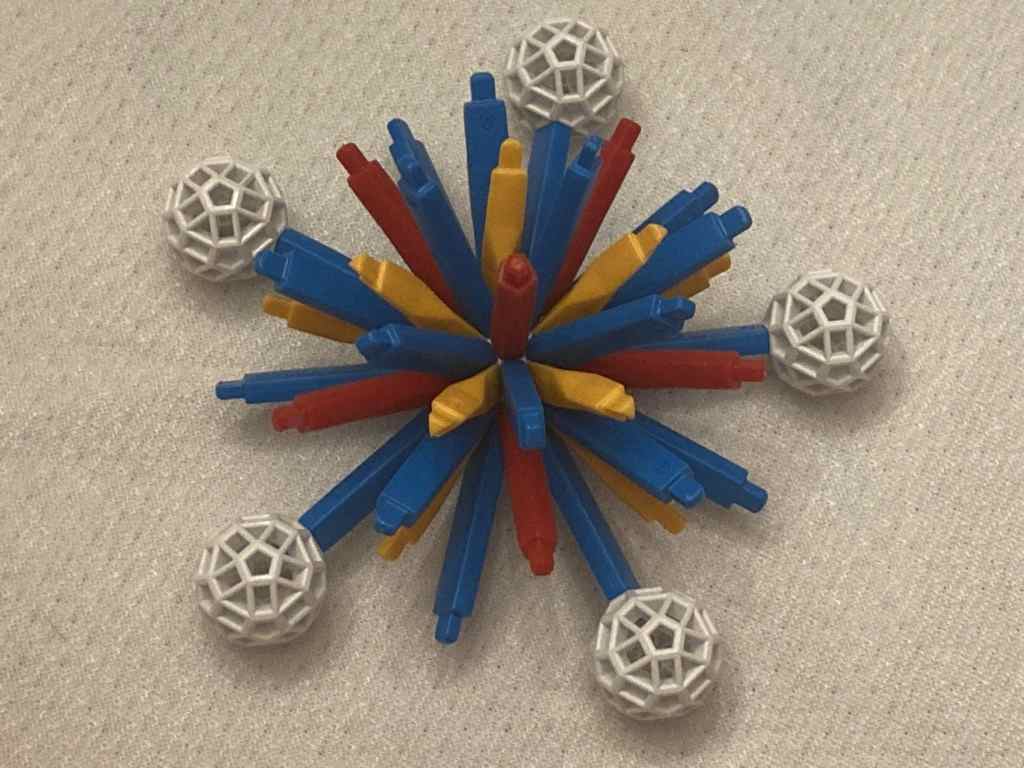
"Icosahedral" symmetry
The semantics of the design paradigm for the particular types and orientations of the sockets is generally described as "icosahedral symmetry". This refers to the regular icosahedron. It could equally well be thought of as "dodcahedral" symmetry, or one of the several Archimedean solids or their duals that share that symmetry. The important thing to notice is that there is a pair of sockets in the connector for each pair of vertices (6 pairs), edges (15 pairs), and faces (10 pairs) of the icosahedron, 2×(6+15+10)=62 sockets in all. Here by "edge" we specifically mean the midpoint of an edge, and "face" likewise means the center of a face.
Any pair of vertices (or edges, or faces) defines a single straight line or "axis" through which there are an infinite number of planes. However only a few planes happen to intersect another axis (i.e. the axis of some other pair of vertices, edges, or faces). A fixed set of "multiple-axis planes" can be identified, and they can be classified by the number and types (red, yellow, and/or blue) of axes that are in the plane.
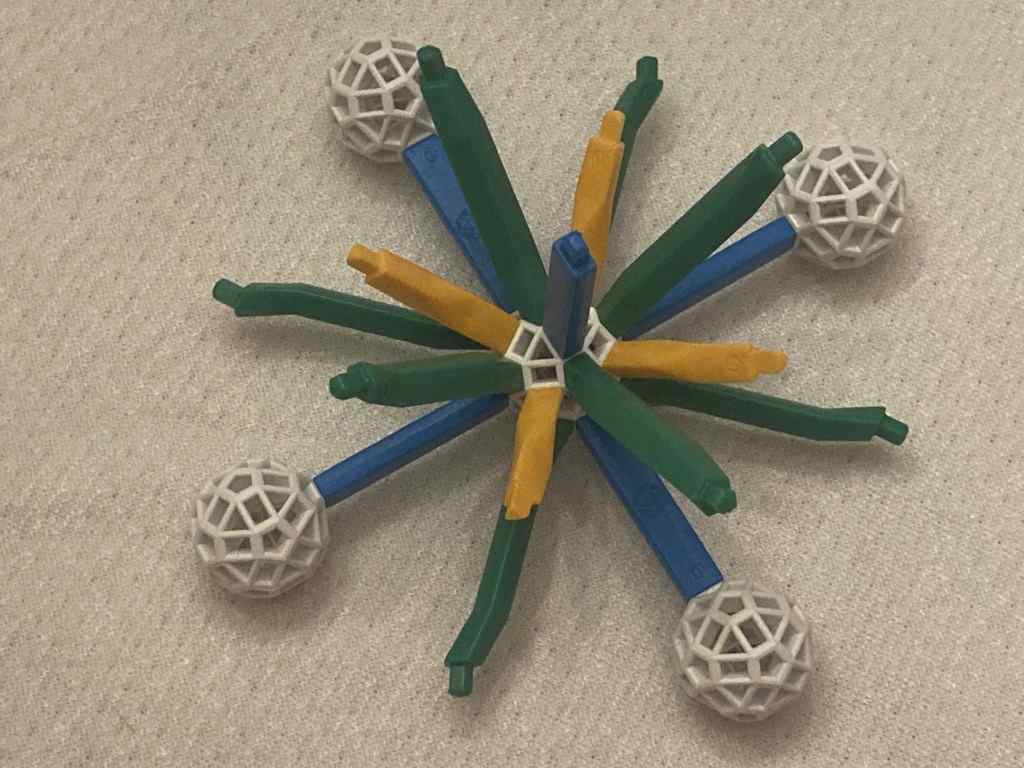
"Octahedral" symmetry
In addition to the above, and specifically to permit connection along edges that line up with the cube, octahedron, and tetrahedron (and other designs relating to those types of symmetry) additional green connectors are added. These fit the pentagonal socket holes but skew their angle so as to exactly bisect the angle between a pair of (perpendicular) "blue" axes. The green and blue together thus form the angles needed for the octagon (135 degrees) as in a truncated cube; the triangular faces of that object have three green edges at 60 degree angles and are in the planes needed for the tetrahedron, etc.. Many other variant angles are possible, as there are 30 additional axis directions of green connectors in addition to the main 31.
Lines and Planes
As seen above the direction axes are named by colours, that are assigned to each direction according to the type of symmetry it has, or the relationship it has to other lines.
Planes can be described by telling which colour lines are in that plane, and at what angle(s) they meet; or by telling what (colour) line is perpendicular to the plane. If everything is done in a consistent way, these two approaches are equivalent.
Star Diagrams
In analogy to the original nomenclature developed for the use of this modeling system (see the Zome primer by Steve Baer, or this annotated version by Scott Vorthmann), a connector with struts that are all on coplanar axes can be called a "star diagram".
Baer identified six types of planes containing multiple axes, and there are 17 variants when green connectors are considered as illustrated here, for a total of 23 variations. Certain angle combinations, such as 60 or 90 degrees, are available in different colours, which can only rarely substitute for each other.
These are arranged with red-yellow-blue sets first, as shown by Steve Baer, followed by variants using "green directions" for any such variants that are coplanar.
The Primary Plane
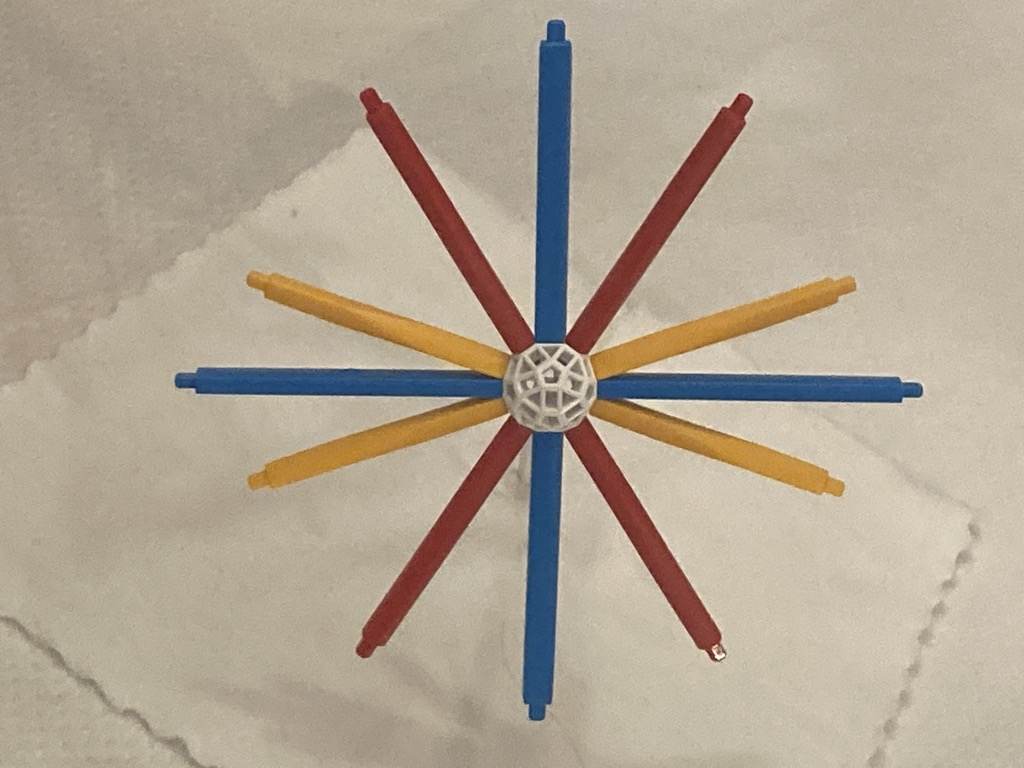
Edge directions in the main (6-axis) R plane
Baer's "R plane" provides the greatest variety of possible angle combinations, with two axes of two-fold rotational symmetry (the blue connectors), two axes of three-fold rotational symmetry (yellow) and two axes of five-fold rotational symmetry (red).
Variants of the R plane using green connectors
|
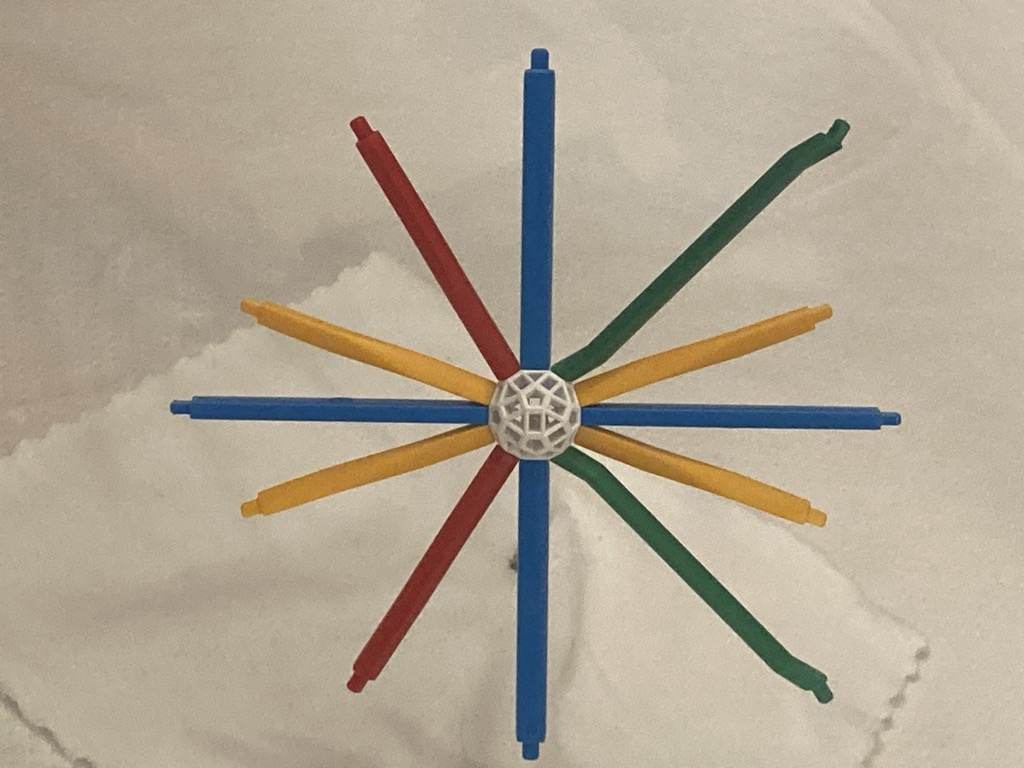
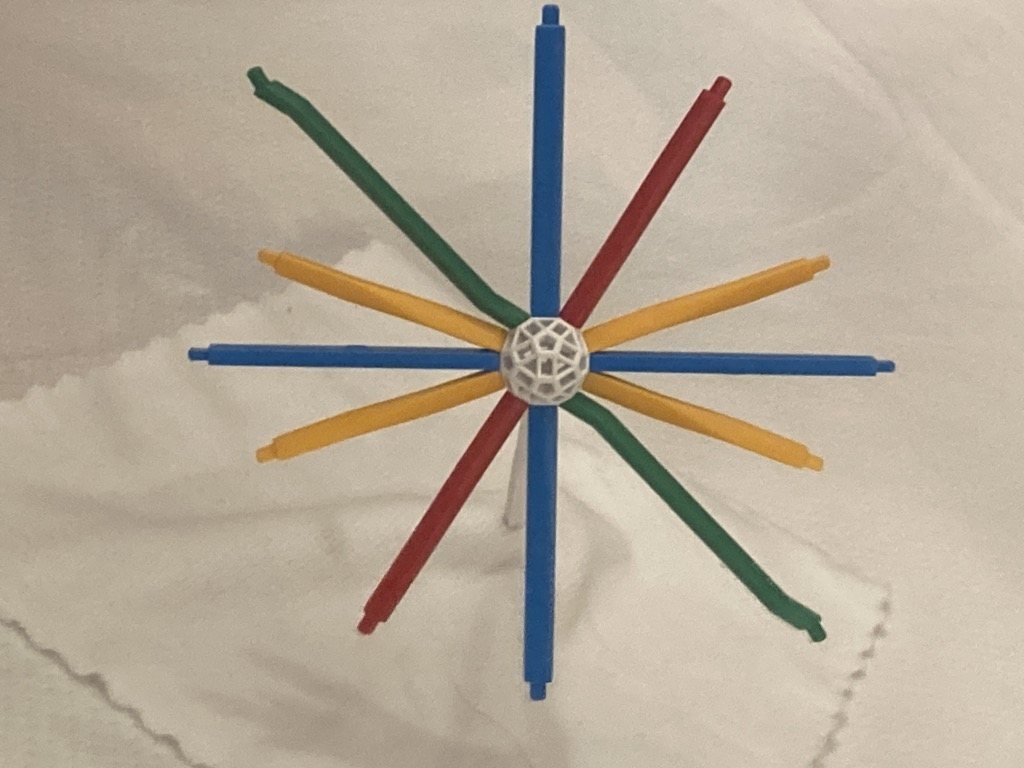
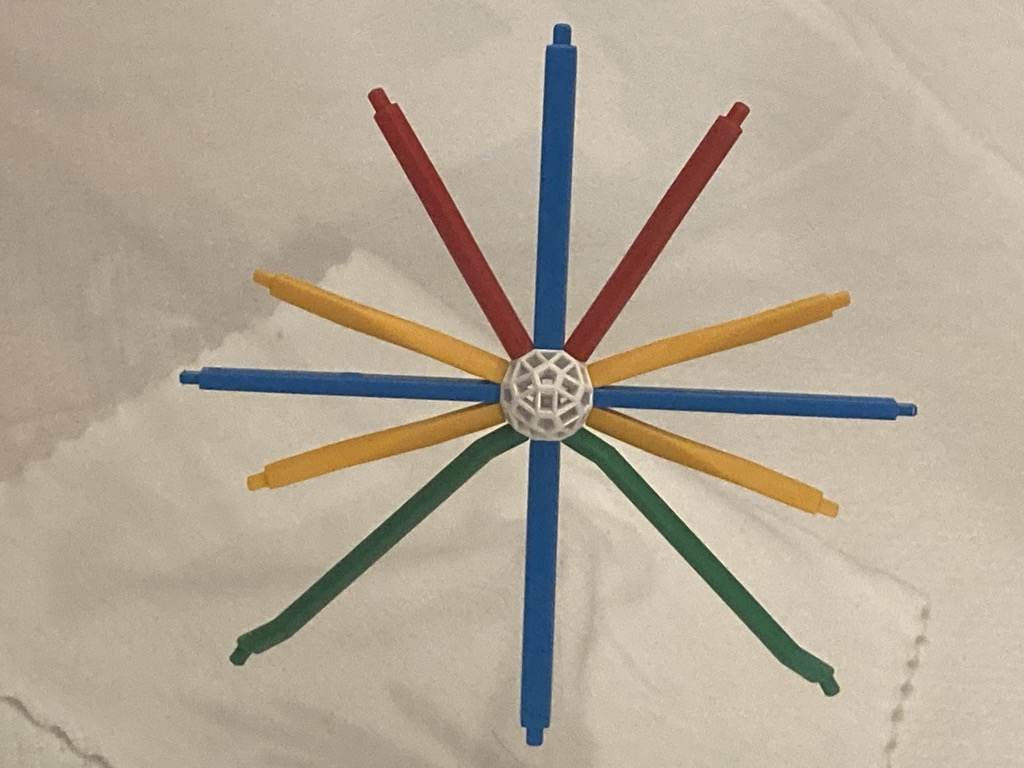
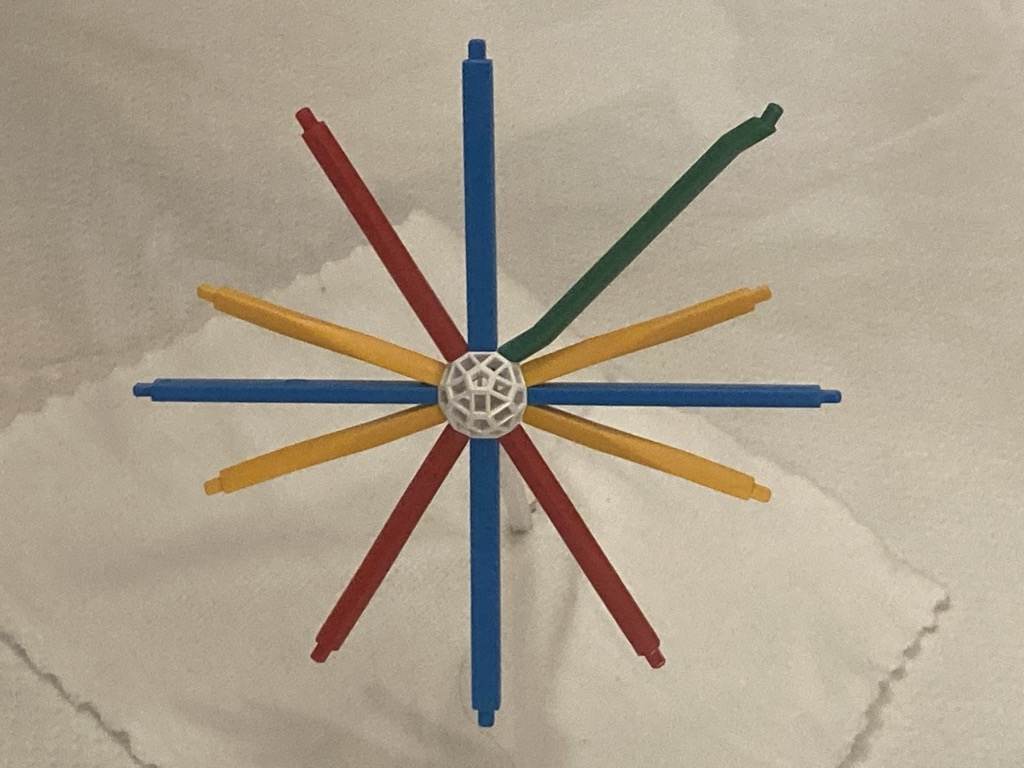
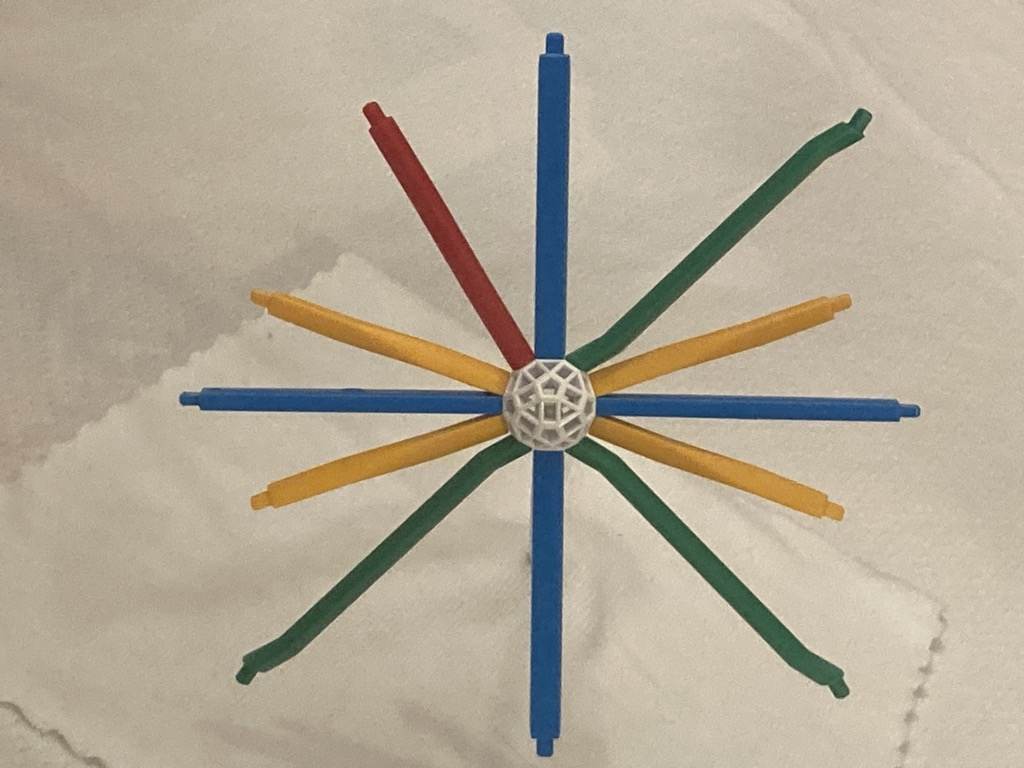
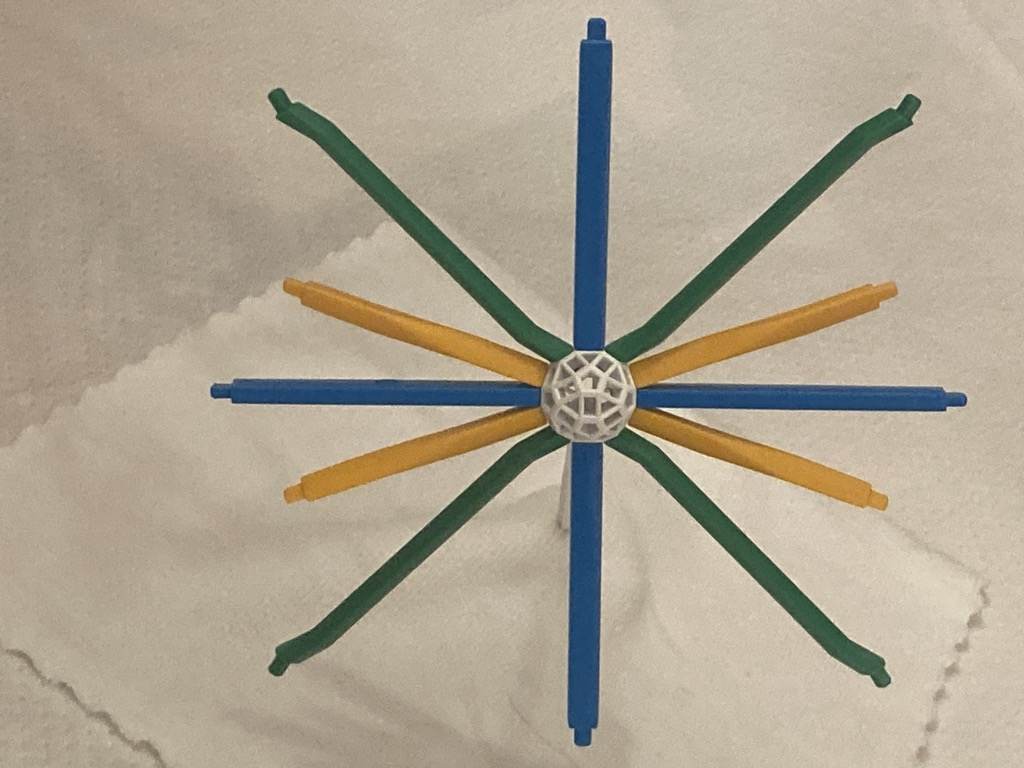
Any one of the red directions can be altered to be exactly 45 degrees with respect to the blue, and there are 6 such alterations possible, making for the six variants shown here. Some of these are used in building regular and semi-regular polyhedra with "octahedral symmetry".
The R plane is called the "blue plane" in Scott Vorthmann's vZome. In the article "vZome Icosahedral Orbits" it is described as "the mirror planes that generate the symmetry group", and notes that all three rotational symmetry axes (blue, yellow, and red) exist in "blue" planes.
In this plane, vZome defines additional directions useful for building 4-dimensional projections such as a vertex-first projection of the 120-cell. As described on that page, "maroon" is the diagonal of a 1 by phi4 rectangle, "lavender" is the diagonal of a phi+1 by phi+2 rectangle, and "olive" is the diagonal of a 1 by phi+2 rectangle.
All-Blue Planes
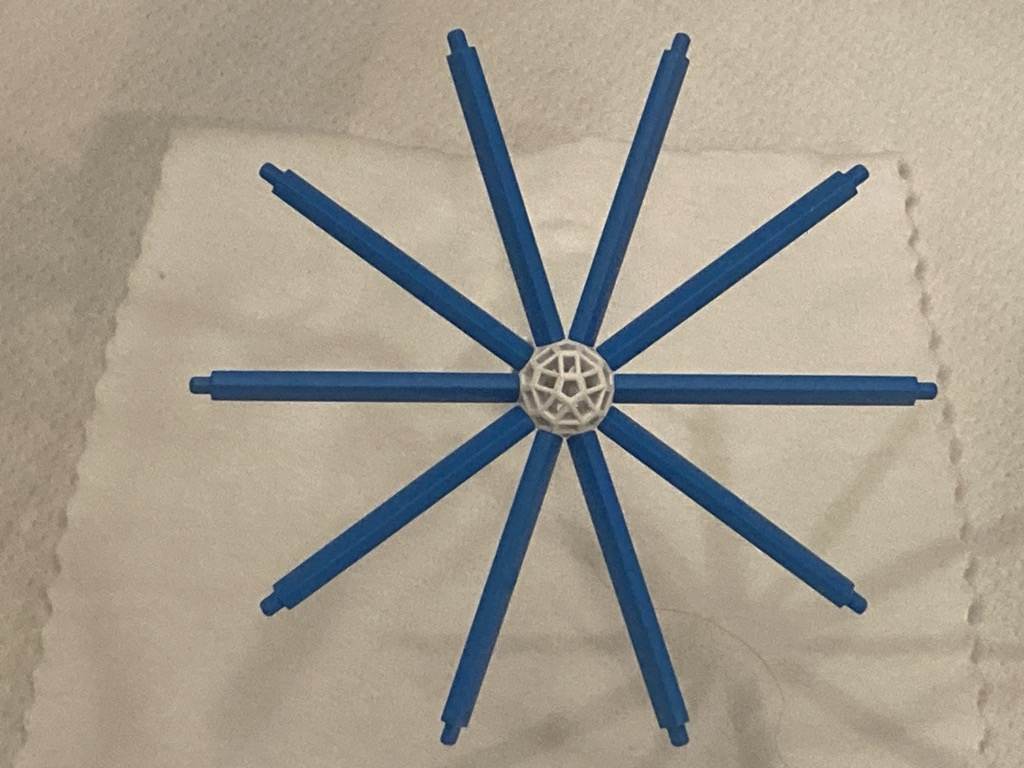
The five-axis blue (T) plane
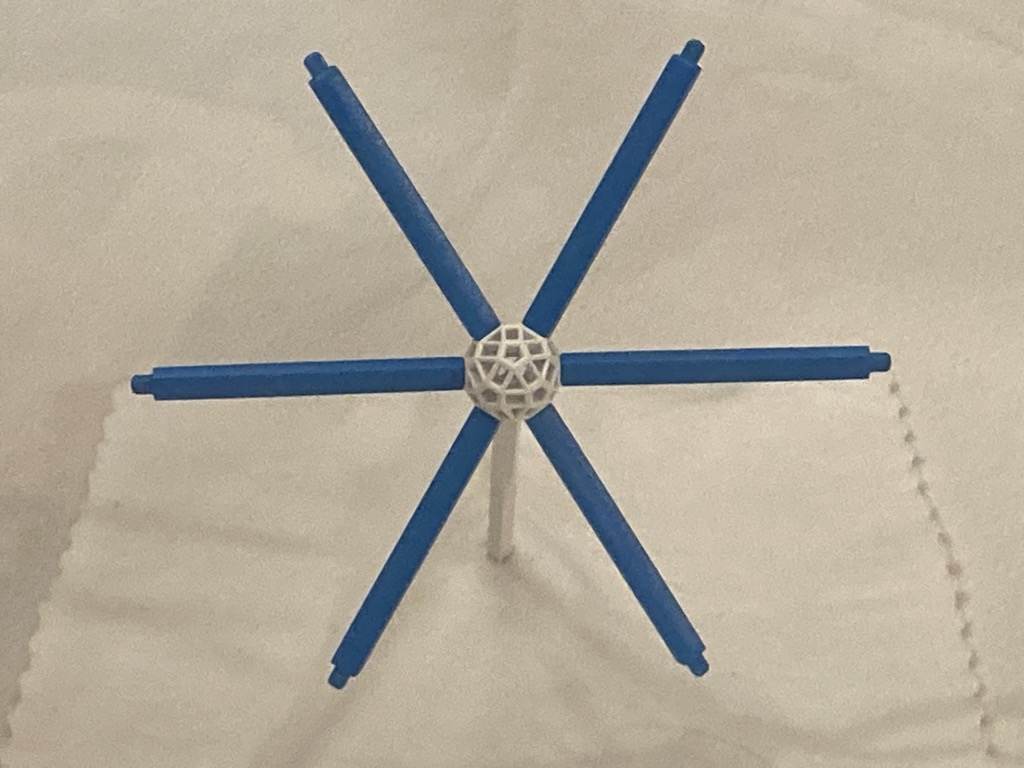
The three-axis blue (V) plane
There are planes containing exactly five of the two-fold "blue" axes, at 36-degree angles, allowing for regular pentagons as in the Platonic dodecahedron, and with three "blue" axes at 60-degree angles allowing for equilateral triangles as in the regular icosahedron. Two blue axes at right angles are available as part of the red-yellow-blue R-plane shown above.
The T plane is called the "red plane" in Scott Vorthmann's vZome (which additionally defines "orange lines" located at 18-degree angles to the blue), and the V plane is called the "yellow plane".
The Many Blue-Green Variants of V
When green connectors are included, the V plane acquires six more axes, for a total of nine axes and eighteen directions — although only six of the twelve green directions may be used at any one vertex.
The variants can be distinguished by noticing the six sectors that are created by using the blue lines to partition the full circle. Within each segment, the green line can move to a left (L) or right (R) position. Here are the base variant in which all are in the R position, and variant 1 in which one sector (at the 12-o-clock position) is in L:
|
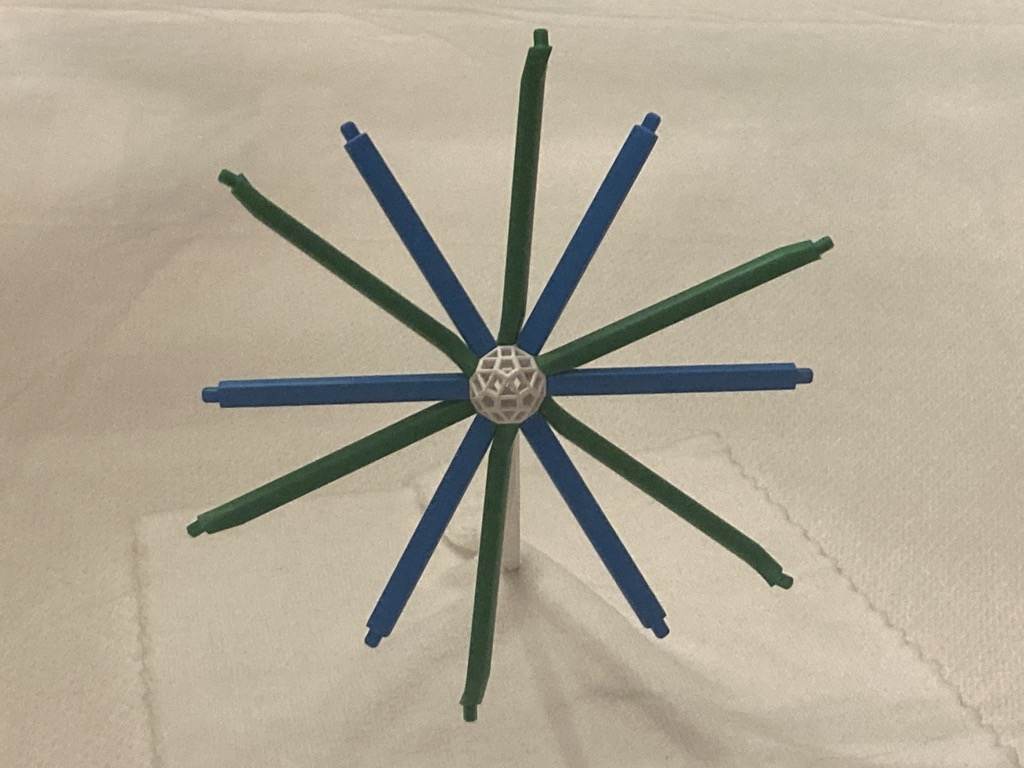
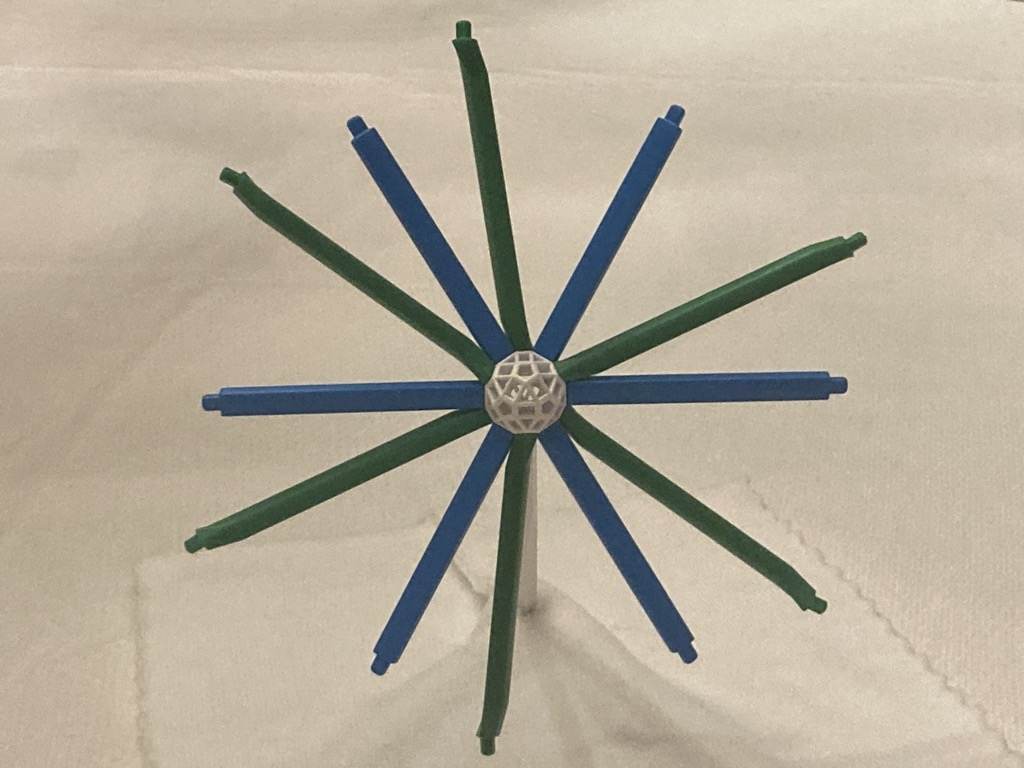
There are nine variants in all. Here they are classified by noting that anything with 4 or more Ls can be flipped over to make a variant with fewer than 3 Ls; and the ones with 3 each of L and R happen to be all identical to themselves when flipped over:
\ R / \>L< / \>L< / \>L< / \>L< / R \ / R R \ / R R \ />L< R \ / R R \ / R ____\/____ ____\/____ ____\/____ ____\/____ ____\/____ /\ /\ /\ /\ /\ R / \ R R / \ R R / \ R R / \>L< R / \ R / R \ / R \ / R \ / R \ />L< \ 0 1 2-ortho 2-meta 2-para \>L< / \>L< / \>L< / \>L< / R \ />L< R \ />L< R \ />L< R \ / R ____\/____ ____\/____ ____\/____ ____\/____ /\ /\ /\ /\ R / \>L< R / \ R >L< / \ R >L< / \>L< / R \ />L< \ / R \ / R \ 3-ortho 3-meta-R 3-meta-L 3-triAll of the above allow for great variety in any one of the V planes (of which there are 10, one plane perpendicular to each of the 3-fold rotational axes of the icosahedron; or equivalently four planes for each of the five cubes inscribed in the dodecahedron which counts each of the planes twice). Viewed as four planes in relation to the cube, the V planes provide the dihedral angles needed for the regular octahedron and related polyhedra like the cuboctahedron. These images are from a Septivium construction gone wild:
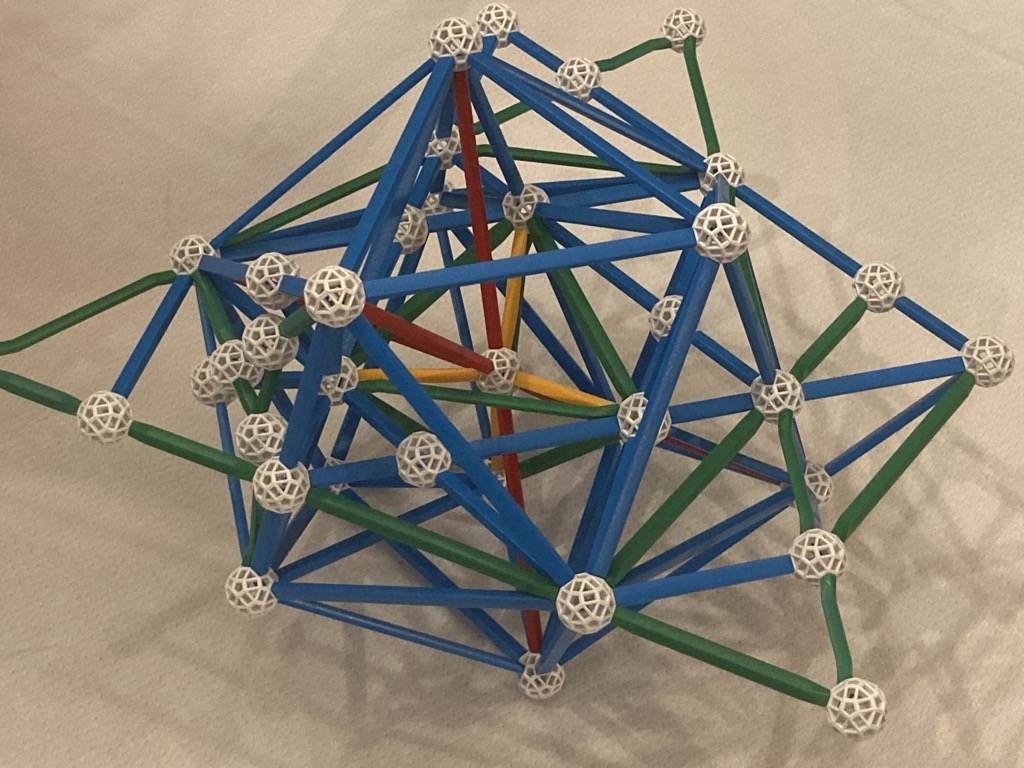
Icosahedron augmented in multiple V planes
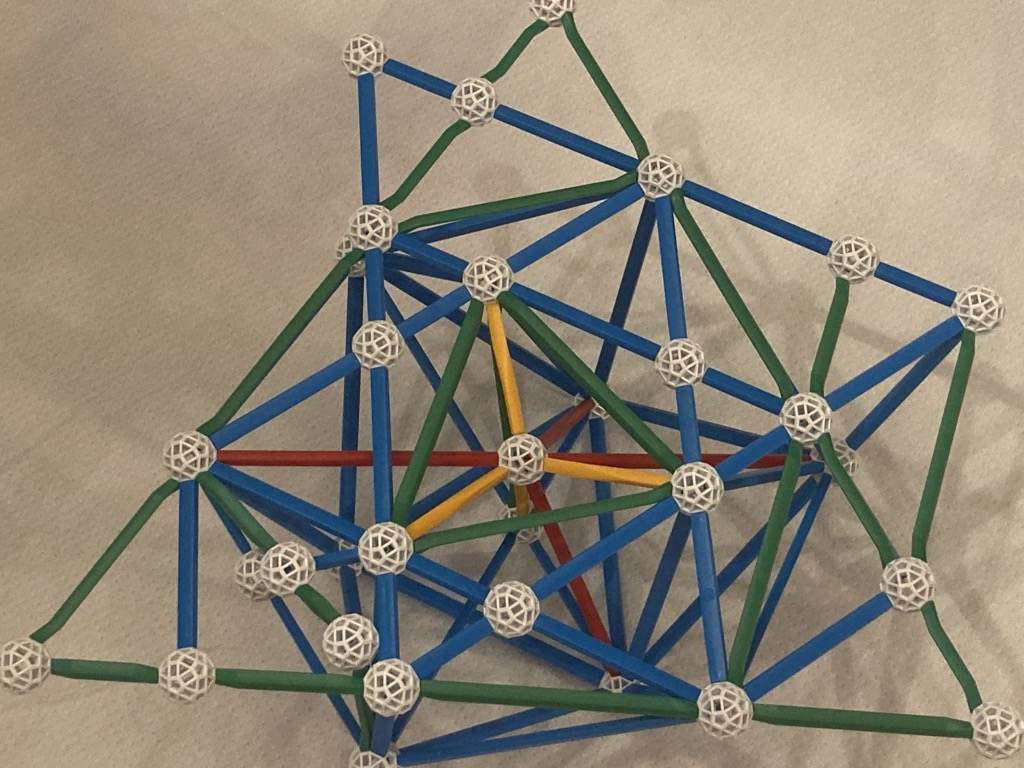
Upper part removed showing one V plane
Blue and green equilateral triangles can be inscribed in each other at multiple angles, and with a total of nine line directions in a single plane, convex polygons with as many as eighteen sides are possible:
Yellow-Blue Planes
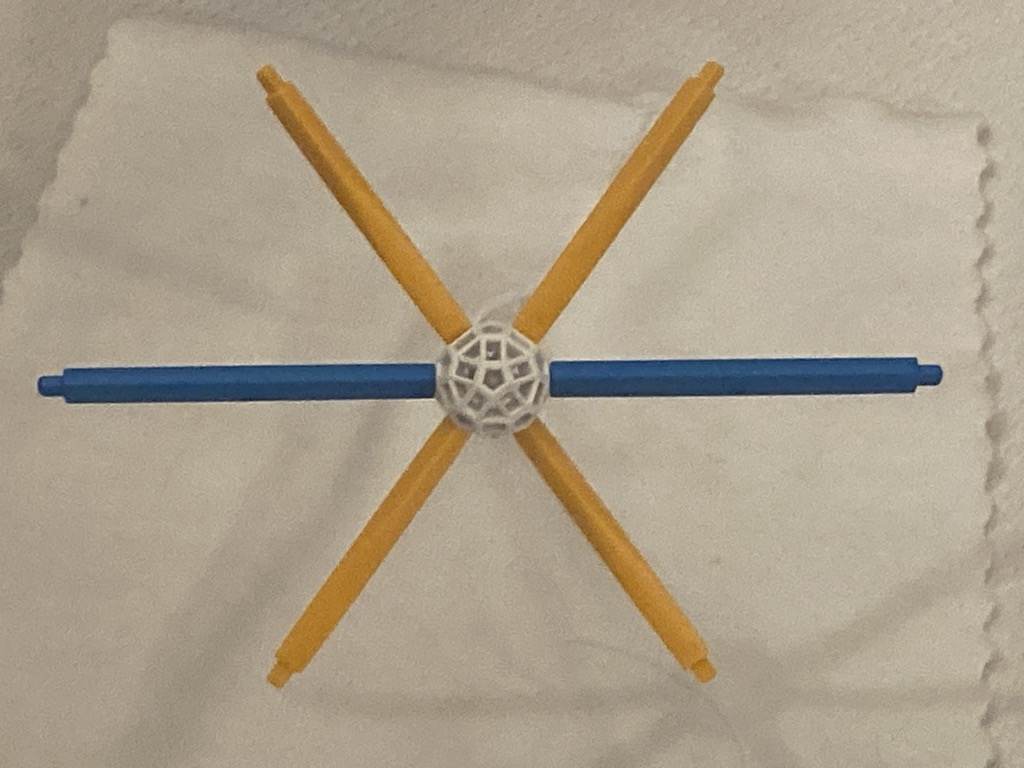
The 3-axis yellow-blue (S) plane
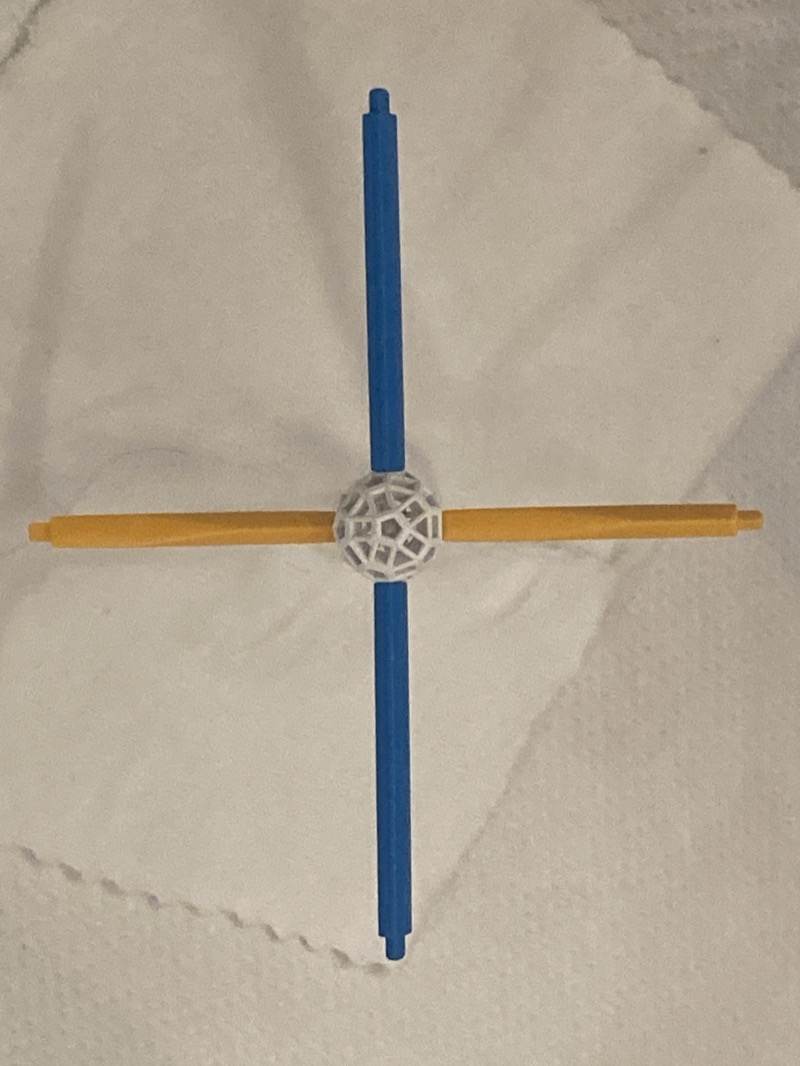
The 2-axis yellow-blue (Y) plane
The planes with one blue axis and two yellow axes (S), and with one blue and one yellow (Y), can be used to make the triangular prism, hexagonal prism, and a squashed tetrahedron that is often useful. The following approximation of Johnson solid 14 also uses the R plane:
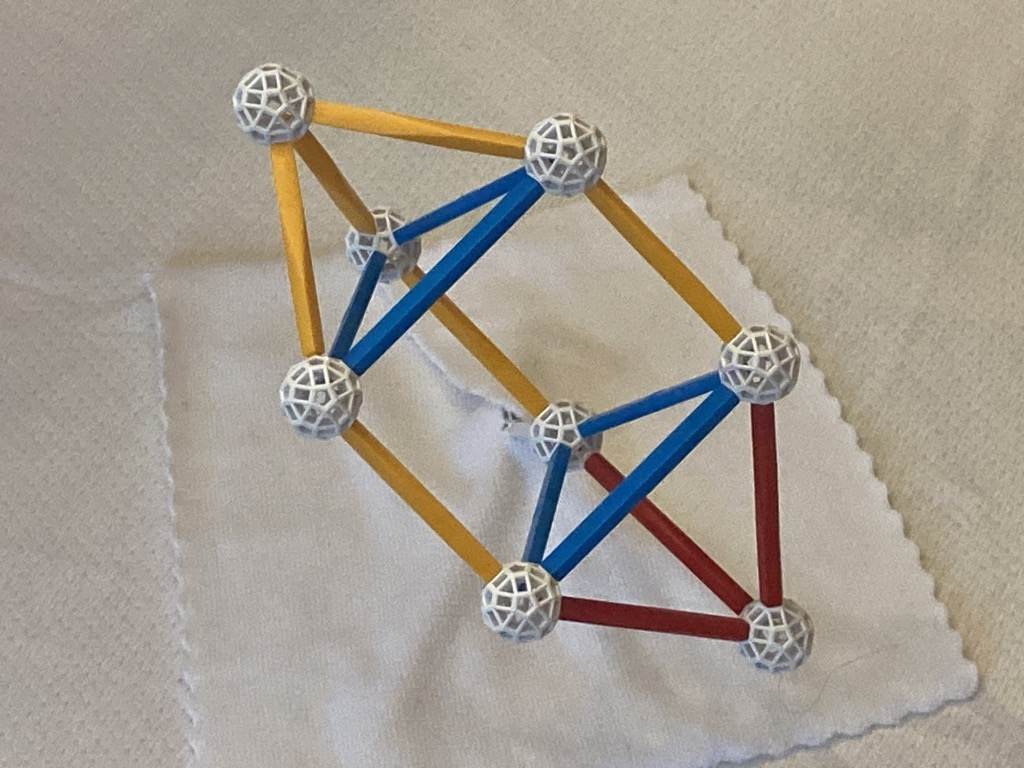
Approximation of Johnson solid j14
The S plane can also have green added:
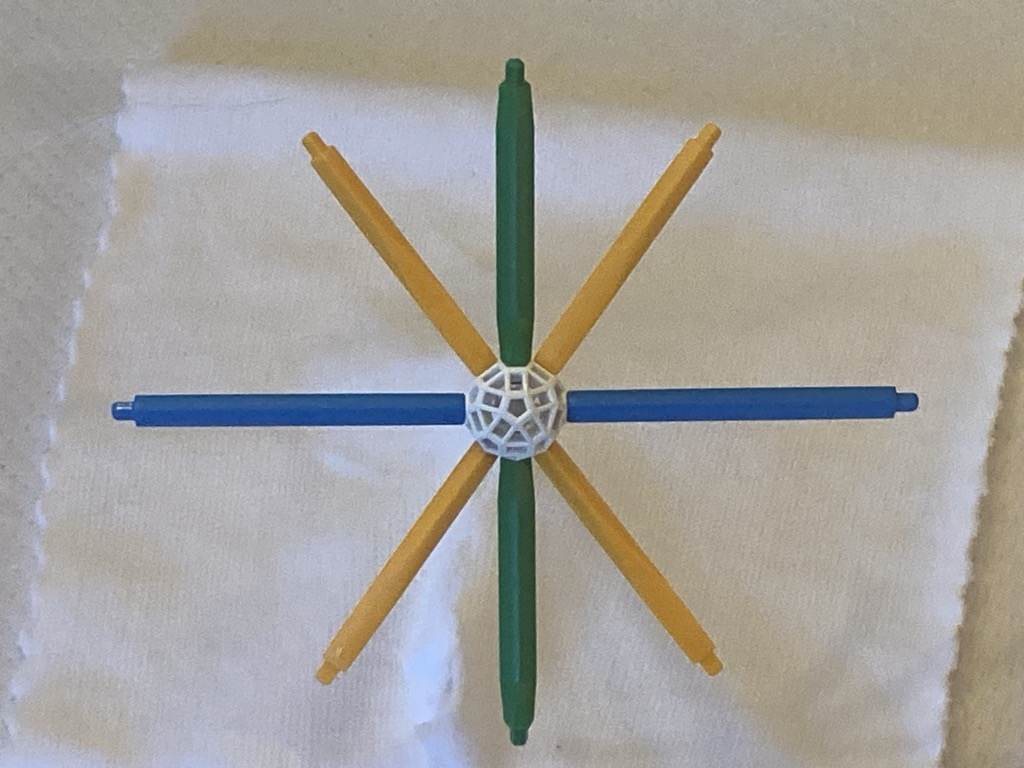
S plane with green added
The S plane (with red, yellow and green lines as shown, together with additional line directions such as "olive") is called the "green plane" in Scott Vorthmann's vZome.
Finally, there is Baer's "X" plane, with one blue axis perpendicular to one red axis:
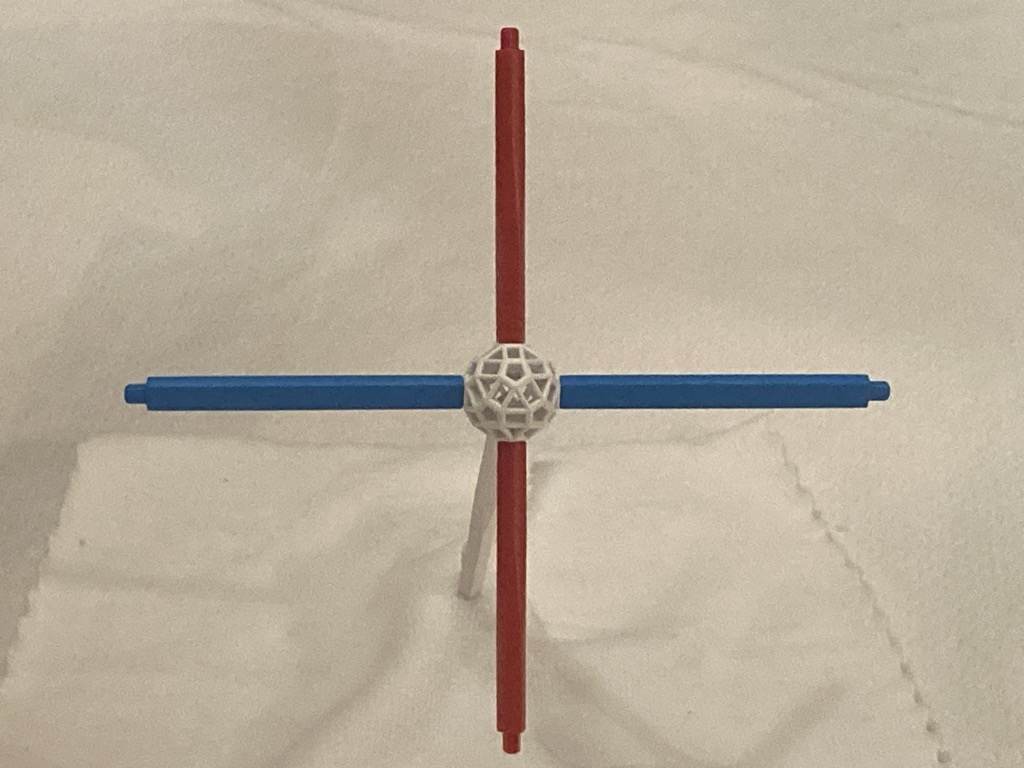
The 2-axis red-blue (X) plane
Because it involves red, this one allows for three variations in which both red connectors are replaced with green (replacing just one red with green does not work, as the result is no longer planar). All replacements result in a plane that tilts in a different direction (and so, might deserve a new letter), and one of them happens to coincide with the S plane described earlier:
|
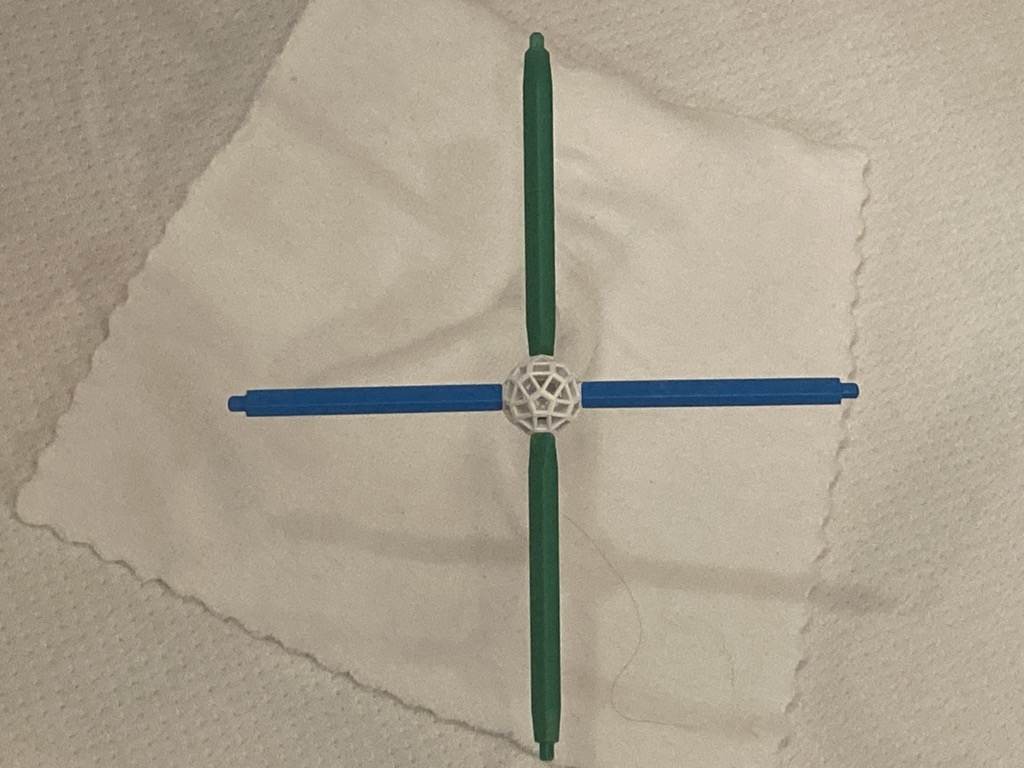
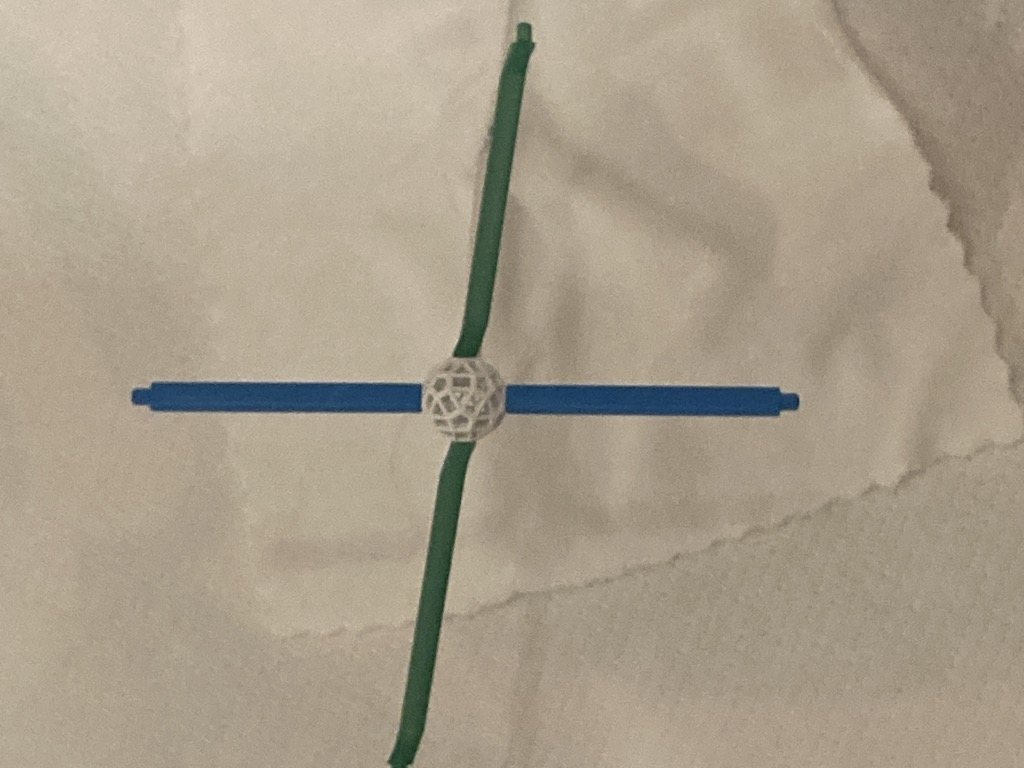
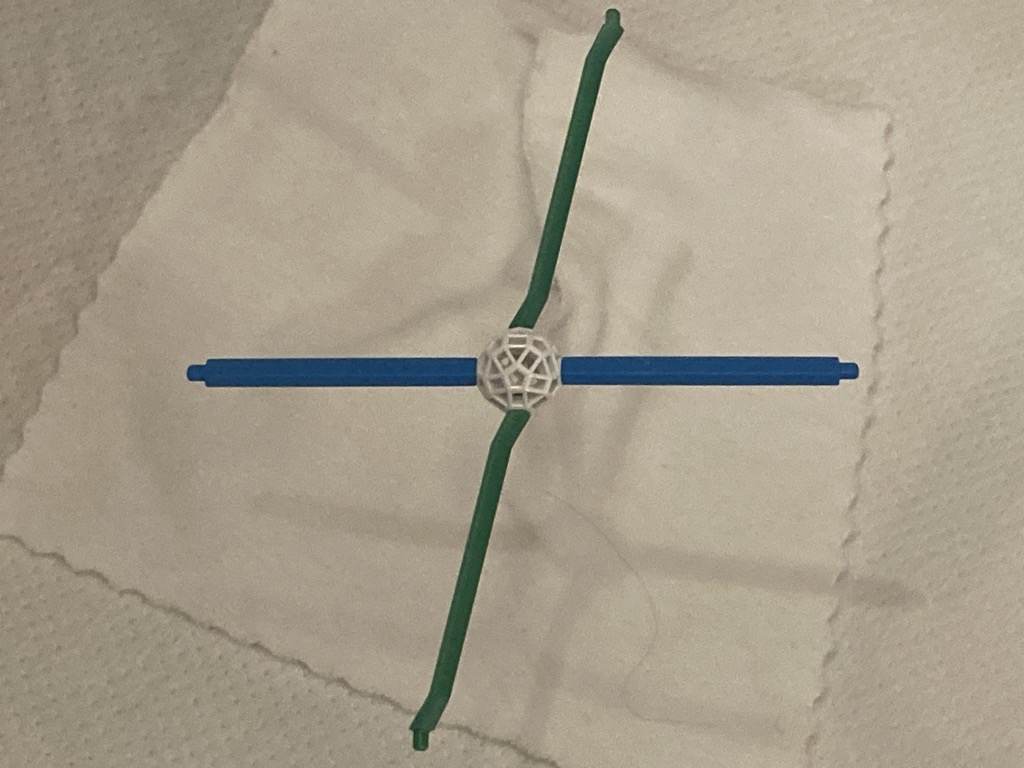
These differ only in the position of the green connectors in their sockets, but that changes the available dihedral angle for combining with other planes.
The two red-and-green combinations are planes that do not contain any yellow or blue axes (a third red and green combination appears as a subset of the R plane.)
Purpose
The primary purpose of the star diagrams is to identify what colour(s) to use to achieve certain polygonal shapes and what orientations (planes) they will be in as related to other polygons, when one knows what polygon(s) are needed; or alternatively, find out what triangles can be made in a given plane (and therefore what polygons are possible, as all polygons can be dissected into triangles). All edges of a polygon must be in the same plane. Because the Zometool's design ensures that the universal connectors (socketed balls) are always in the same orientation with respect to each other, this means that a polygon's edges must all be parallel to the edges in one of these "star diagrams". For example:
- An equilateral triangle or a regular hexagon may only be made using all blue edges (second photo upper-right) or all green (third photo, left).
- A regular dodecahedron has regular pentagons for faces, and a regular pentagon has edges at 72-degree angles to each other. These must be built with the "blue" connectors using the arrangement seen in the second photo, upper-left.
Polyhedra, Zometool, and Geometry Index
This page was written in the "embarrassingly readable" markup language RHTF, and was last updated on 2024 Apr 23.
 s.30
s.30