Size Scales of the Universe at Home
In the Hayden Planetarium at the American Museum of Natural History in New York City is an exhibit called Scales of the Universe. The exhibit consists of a series of models that, combined with the "Hayden Sphere" that contains the planetarium theatre and dominates the room, show the relative sizes of objects of all sizes. For example, in this picture a model of the Hayden Sphere reflects how small it would have to be if Meteor Crater in Arizona were reduced to the size of the real Hayden Sphere (which is out of view to the right):
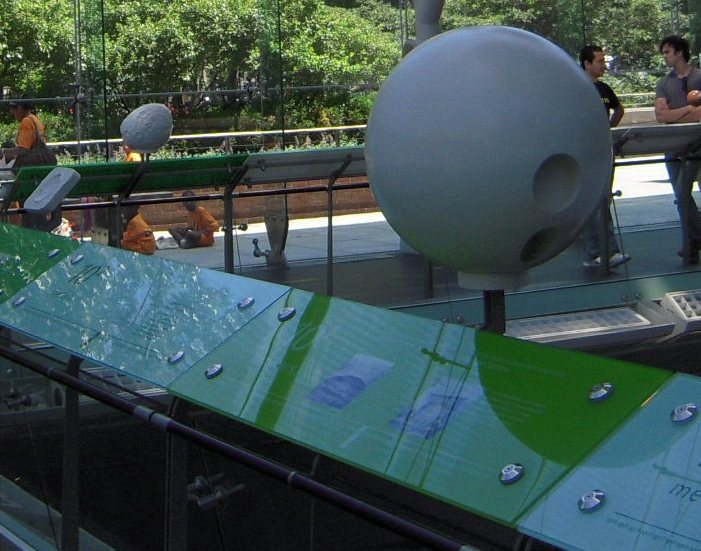
"If the Hayden Sphere is the size of Meteor Crater,
then this model is the relative size of the Hayden Sphere."
To the left you can see a small scale model of Meteor Crater, and behind it, a model of Saturn's moon Janus. The Meteor Crater model shows how small Meteor Crater would be if Janus were the size of the Hayden Sphere; the Janus model shows how small Janus would be if the Earth were the size of the Hayden Sphere; and so on.
I like these sorts of things and decided it would be great to make a set of models of my own.
My models clearly had to be smaller than those in the public exhibit, for ease of construction as well as for storage. I also wanted to avoid having to find a huge object to use in place of the Hayden Sphere, so I decided to use the room itself as a substitute for the Hayden Sphere. This provides three advantages:
- The "exhibit" can be moved to any room of nearly the same size, and still work.
- No need to transport, assemble and/or inflate a large object.
- The viewer can hold the small model in the center of the room, to easily visualize its relative position within the larger object represented by the size of the room. This is particularly relevant for the astronomical scales, such as the place of the inner Solar System in relation to the Scatted Disc. The viewer can picture herself being "inside" the Scattered Disc, "looking in" on the Solar System in the palm of her hand.
The room I used for this project is a bedroom in a three-family home in Cambridge, MA. It is a square room of about 11 feet, which is a fairly typical size for rooms found in most homes and apartments in the United States. The ceiling is far too low for the room to be a cube — although that would improve the exhibit a bit, it is not essential.
So "This Room" takes the role of "Hayden Sphere" in my exhibit. I also made the wording more clear by including the scale explicitly. For example, the caption corresponding to the above "Meteor Crater" example is:
At a scale of 1/51.2,
the Vehicle Assembly Building would be the size of this room,
and this room would be the size of this model.
This type of wording was not available to the Rose Center exhibit designers because they wanted to carve their captions into metal plates, which would be expensive to alter should a dimension change be necessary. Since nearly all of the dimensions in the exhibit are subject to change with improvements in science, the size scales might change too.
In the Hayden exhibit, most of the models are about 50 to 100 times smaller than the Hayden Sphere (models about 25 to 50 cm in size; Hayden Sphere diameter 26.5 meters). The Rose Center models represent a sequence of objects of progressively smaller size: the Virgo supercluster, our Local Group of galaxies, the Milky Way Galaxy, the globular cluster M80, the Oort Cloud, the Kuiper belt, Rigel (a supergiant star), the Sun, the Earth, Saturn's moon Janus, Meteor Crater in Arizona, the Hayden sphere, a human brain, a raindrop, a red blood cell, a rhinovirus, and a hydrogen atom.
I could have used the same sequence of steps for my models. Because my room is about 1/8 the size of the Hayden Sphere, all the models would be of a managable size to build. However, I saw many opportunities for improvement, which are explained in the rightmost column in the table:
|
Inflationary Multiverse
There no object larger than the inflationary multiverse with which to compare it.
There are theories of cosmic inflation that predict that many universes, including our own, were created out of the same process. These universes are invisible to one another because they are separated by excessively large distances in spacetime. (In the jargon of general relativity, they are permanently beyond our "event horizon"). Also, they are of different ages and might have different physical laws (depending on the inflation model in question).
See also the entries for e1037 and 101054 on my numbers page.
Entire Universe
Due to the unknown size of the inflationary multiverse, there is no scale at which it can be compared to our entire universe.
The "entire universe" includes everything that was created at the same time that the matter and energy in our galaxy was created. In the inflationary multiverse theory (see above) it is just one "bubble" of many that emerged out of inflation at different times.
It is known that there is much more to the universe beyond what is observed. In particular, the cosmic microwave background radiation has a very uniform pattern: its "brightness" in one part of the sky is never any more than 1 part in 104 brighter than in any other part of the sky. From this and other similar observations it is possible to show that at an earlier point in the Universe's history, spacetime grew faster than light for a brief period (called inflation). This growth was so great that the entire universe is at least 1023 times larger than the observable universe — and probably much larger even than that. All this extra space, forever beyond the limit of our visibility, is also populated with matter, energy, galaxies, stars and planets.
Observable Universe
At a scale of 1/1045, the entire universe would be much larger than this room, and the observable universe would be much smaller than a proton.
There are different definitions of "observable universe". Generally it has the straightforward meaning "everything that can be observed" — which implies that distant objects are being seen in the past. By this definition, the "observable universe" would include an object like Q0906+6930, which appears to be 12.7 billion light years away, and which is therefore being seen as it existed 12.7 billion years ago. Q0906+6930 is moving away very fast, and so (with the tacit assumption that it still exists) it is now considerably further away.
The very oldest physical objects that can be seen is the cosmic microwave background radiation (radio waves left over from a very early point in the formation of the universe), which gives us a picture of the gaseous hydrogen and helium just as it condensed from a plasma to a normal gas. It is 1.37×10¹⁰ years old (about 14 thousand million). Complicated analysis (see Lambda-CDM model) provides a very accurate estimate of the current size of the visible part of the universe. Its radius is not simply the same as the age of the universe (which would be 13.7 billion light years) because of the effects of comoving distance and general relativity, and changes in the rate at which the universe expands over time. The present radius of the observable universe works out to about 46.5 billion light-years, or 93 billion light-years "across".
Virgo supercluster
At a scale of 1/2.6×1026, the Observable Universe would be the size of this room, and the Virgo supercluster would be the size of this model.
The Virgo Supercluster of galaxies is about 110 million light-years across.
Local group of galaxies
At a scale of 1/5.78×1023, the Virgo supercluster would be the size of this room, and the Local Group of galaxies would be the size of this model.
The Local Group includes everything that can be seen by the naked eye — notably the two Magellanic Clouds, the Andromeda Galaxy, and our own galaxy. Of these, Andromeda is the furthest that can be seen easily with the naked eye. The Triangulum Galaxy (M33, NGC 598) is a little further away and can also be seen by most observers, and with considerable effort M81 (at a distance of 12 million light years) can be seen by experts.
Small Magellanic Cloud
At a scale of 1/1.45×1022, the Local Group of galaxies would be the size of this room, and the Small Magellanic Cloud would be the size of this model.
The Small Magellanic Cloud is a nearby galaxy clearly visible to the naked eye to observers in the southern hemisphere. To the same scale, the Milky Way galaxy would be about 6.5 cm across.
Human radio bubble
At a scale of 1/2.83×1019, the Small Magellanic Cloud would be the size of this room, and Earth's "radio broadcast bubble" would be the size of this model.
As depicted in the movie Contact (1997), there are radio broadcasts traveling away from Earth at the speed of light, which can (in theory) be detected by an extraterrestrial civilization. Earlier signals have had more time to travel, and form a spherical "shell" emanating from our solar system.
Although radio transmissions go back to around 1900, the size of the radio bubble used here (a radius of 65 light years) is defined by the beginning of regularly-scheduled high-power television broadcasts in the late 1940's. Raymond Harris provides an illustration showing many notable stars within this radius, and this table of known exoplanetary systems within the same distance. Here is a cartoon illustration of the radio bubble relating television programmes to nearby stars that were receiving those programmes in the year 2008.
With a radius of 65 light years, the radio bubble is 130 light years across. Of comparable size is the Local Bubble, a "cavity" of relatively less dense space about 300 light years across. Within this "bubble" the density (50,000 atoms per cubic meter) is about half that of the immediately surrounding region. This is believed to have been caused by a supernova explosion within the past 2 to 4 million years. The supernova would have also left a neutron star remnant resembling the "radio-quiet pulsar" Geminga.
See also the local bubble article on Raymond Harris's site.
Oort cloud
At a scale of 1/3.55×1017, the Human radio bubble would be the size of this room, and the Oort cloud would be the size of this model.
We know of the existence of the Oort cloud through deductive logic and observation of comets. Comets like Halley's only "glow" for a limited amount of time, before using up all their volatile material (ice) and becoming small asteroids. In order for there to be any comets now, "new" (previously unheated) comets must be coming in from some cooler place.
The origin of the Oort cloud is explained by the Nice model, a computer model that also explains most of the other features of the Solar system. In this model, Neptune began in an orbit between Saturn and Uranus, and there were a much larger number of Pluto-like objects beyond Uranus. These objects gradually acquired elliptical orbits like that of Halley's comet through gravitational interactions with the large planets, causing the latter to drift outward in their orbits. When interacting with Jupiter, the small bodies were put into orbits that take them out to a very large aphelion (in the area called the Oort cloud) and remain there because their interaction with the other large planets cause their perihelion to grow as well.
Through this process Jupiter drifted inward slightly, while the other three large planets drifted outwards, and Uranus and Neptune switched places.
Scattered disc and Kuiper belt
At a scale of 1/4.34×1015, the Oort cloud would be the size of this room, and the Scattered disc would be the size of this model.
The Scattered disc and Kuiper belt are only partly explained by the Nice model (described above under "Oort cloud"). In particular, the origin of the "cold" Kuiper objects like Sedna (which have redder surfaces and appear to have been formed further from the Sun) is still poorly understood.
Two other classes of objects are explained by the Nice model: the "hot" Kuiper objects (which have grayer surfaces like the asteroids) probably formed at a distance near that of Jupiter and were pushed outwards. The scattered disc objects reached their current location by being in an orbital resonance with Neptune and gradually shifting outwards as Neptune drifted outwards.
The star Enif (in Pegasus)
At a scale of 1/8.67×1012, the Scattered disc would be the size of this room, and the star Enif would be the size of this model.
Enif, or Epsilon Pegasi, is an orange supergiant star believed to have a diameter about 150 times as great as the sun. It varies in brightness from magnitude +0.7 to +3.5, with corresponding changes in size as well as shape (it is not uniformly spherical). Within a few million years it will either become a supernova or a white dwarf (which fate is unknown because this depends on its mass, which is not know well enough).
The Sun
At a scale of 1/6.07×1010, Enif would be the size of this room, and the Sun would be the size of this model.
The Sun has a core with a diameter about 22% of the Sun's diameter, two large intermediate zones called the "radiative zone" and "convective zone", and relatively thin outer layers called the photosphere and chromosphere.
The Earth
At a scale of 1/4.02×108, the Sun would be the size of this room, and the Earth would be the size of this model.
The Earth has three large concentric interior regions, called the inner and outer cores and the mantle.
Epimetheus (moon of Saturn)
At a scale of 1/2,300,000, the Earth would be the size of this room, and Saturn's moon Epimetheus would be the size of this model.
Saturn's moon Epimetheus (moon) shares its orbit with Janus (moon) and for a long time astronomers did not realize they were observing two different objects in the same orbit.
The Vehicle Assembly Building
At a scale of 1/12,400, Epimetheus would be the size of this room, and the Vehicle Assembly Building would be the size of this model.
NASA's Vehicle Assembly Building was used to assemble each of the Apollo missions to the moon and the Space Shuttle missions to low Earth orbit. Ranked by enclosed volume, it is one of the largest buildings ever built.
This Room
At a scale of 1/51.2, the Vehicle Assembly Building would be the size of this room, and this room would be the size of this model.
This exhibit is intended to be used in a room that is roughly 12 feet (3.65 metres) square.
A human pituitary gland
At a scale of 1 to 1, this room is its actual size, and a human pituitary gland is the size of this model.
The anterior portion of the pituitary gland generates the growth hormone that, to a large extent, determines how tall an individual person will become.
A human egg cell, zygote, or morula
At a scale of 314×, a pituitary gland would be the size of this room, and a human egg cell would be the size of this model.
Every person began as a fertilized egg (zygote), which is sphere-shaped and roughly 0.1mm in diameter. The embryo has this size for about the 6 days of development.
A staphylococcus bacterium
At a scale of 34,600×, a human egg cell would be the size of this room, and a staphylococcus bacterium would be the size of this model.
There are several varieties of staphylococcus bacteria that live on the skin; and some can also cause infections and disease.
A hemoglobin molecule
At a scale of 5,770,000×, a staphylococcus bacterium would be the size of this room, and a hemoglobin molecule would be the size of this model.
Hemoglobin is an important molecule in blood that helps transfer oxygen from the air throughout the body. Without it, the dissolved-oxygen capacity of blood would be 70 times lower.
Many other important biological molecules are of comparable size.
A Hydrogen atom
At a scale of 577,000,000×, a hemoglobin molecule would be the size of this room, and a Hydrogen atom would be the size of this model.
Hydrogen is the most common atom in the universe. Almost all normal stars (like the Sun and Enif, see above) are mostly hydrogen. The exceptions include late-stage giant stars, white dwarfs, and non-atom stars like neutron stars.
A muonic Hydrogen atom
At a scale of 1.08×10¹¹×, a Hydrogen atom would be the size of this room, and a muonic Hydrogen atom would be the size of this model.
Muons are the most numerous cosmic-ray particles at sea level. Every minute, about 104 muons arrive at every square meter of the Earth's surface. Typically the muon will penetrate a distance of over 1 kg/cm2 (about 10 meters through water, less through denser material) before interacting with an atomic nucleus. Depending on your size, a muon interacts with an atom in your body about 500 to 1300 times per minute.
When the muon interacts with a nucleus, it begins to "orbit" the nucleus just as an electron would. Because of the muon's higher mass, its wavefunction (charge distribution) is correspondingly smaller. The muon thus spends nearly all its time at a distance about 200 times closer than an electron in the innermost "shell" of the atom. One of the atom's electrons is displaced by this process.
If the nucleus happens to be a Hydrogen nucleus, the result is a muonic Hydrogen atom, an atom that behaves just like a Hydrogen atom but is 207 times smaller. This atom lasts until the muon decays (its half-life of 2.2 microseconds) after which the muon produces a normal electron and two neutrinos. The two neutrinos leave without interacting with anything, and the atom returns to normal.
Given that your body is 10% Hydrogen by mass, there are about 50 to 130 times per minute when a muonic Hydrogen atom exists within your body.
At a scale of 2.23×10¹³×, a muonic Hydrogen atom would be the size of this room, and a proton would be the size of this model.
The Proton is the atomic particle, consisting of three quarks, which comprises the nucleus of a Hydrogen atom. It is about the same size and mass as a Neutron, and these two types of particles account for nearly all of the mass of normal atomic matter.
An electron or a quark
It is unknown how small an electron or a quark is in comparison to a proton.
The quark and electron are the most fundamental particles making up ordinary atoms. They are too small to have a "size" in any ordinary sense of the word, although there are certain definitions of "size" that impose a practical upper limit.
Footnotes
1 : C. R. Nave, Inflationary Period (part of HyperPhysics database at Georgia State University)
Bibliography
[2] Alan H. Guth, Eternal inflation and its implications, 2nd International Conference on Quantum Theories and Renormalization Group in Gravity and Cosmology (IRGAC2006), Barcelona, Spain, 11-15 July 2006.
This page was written in the "embarrassingly readable" markup language RHTF, and was last updated on 2022 Mar 28.
 s.30
s.30