Taking the Train between Haneda and Fujinomiya
This describes most of the tasks needed for train travel in Japan. I got the details (names of stations and trains, platform number, train times, etc.) by using Apple Maps and requesting directions from "Haneda Terminal 3 station" to "Fujinomiya station". To make things specific I checked all the trains running on a Friday and a Tuesday, from 7:00 AM to 7:00 PM to cover the commuting times and work day.
Contents:
Haneda to Fujinomiya
Total travel time (either direction): 2 hours 40 min
Begin with a Keikyu train to Shinagawa station, which a majority of Haneda airport travelers often do if going somewhere in Tokyo. The destination of your train can be Aoto 青砥, Imba-Nihon-Idai 印旛日本医大, or even Narita 成田; you'll get out at Shinagawa 品川.
Once in Shinagawa station, find a Shinkansen ticket machine and purchase for each person a one way, reserved seat (but not "green car"/first class), from Shinagawa to Atami. When choosing what train to ride, don't choose a "Hikari" train, choose a Kodama こだま (with departure time that you can get to without running).
Using the ticket machines is described below but this is the most important part:
Each reserved Shinkansen ride requires two "fares" which you'll get printed on a single paper ticket, (or on two separate tickets, see note 1). One fare is for riding a train from A to B, and the other is an upgrade to a bullet train (unreserved, reserved, or first-class).
Because there are two fares, at some point the machine asks you to "Select a base fare ticket" (or "basic fare"). This is required: do not opt to "purchase limited express ticket only". That's only for people who have a Japan Rail pass and want the bullet train upgrade (but all is not lost, see note 2).
Total price per person one way should be ¥4,270 (¥1,980 basic fare from Shinagawa to Atami, plus ¥2,290 to make that trip in a bullet train reserved seat).
There is no Shinkansen ticket machine at Fujinomiya, so you'll probably want to use the machine at Shinagawa to purchase your return tickets: reserved seat, Atami to Shinagawa, one way, (on a Kodama こだま train if there's a choice). According to the app, the price on Monday-Thursday is ¥200 less than on a Friday, Saturday or Sunday. When choosing the departure time from Atami, make sure it's at least 1 hour 35 minutes after you leave Fujinomiya: see below for times that trains leave Fujinomiya on Tuesday the 8th.
The turnstiles for Shinkansen are all the way at the east end of the station, platforms 23 and 24. You put your Shinkansen tickets in a turnstile machine which then gives them back to you. If you have two tickets you put them both in (one at a time).
You also have to tap your PASMO card (to pay for the local train you just rode).
Make sure to take back your paper tickets which the machine just gave you and save them until you get to Atami station.
The southbound Shinkansen trains stop on platform 24. The train will say Kodama こだま (the least-fast type of Shinkansen) and final destination is Shin-Osaka 新大阪 but you only will go a few stops to Atami 熱海. There is one station where the train might wait a few minutes for a super-express to pass it.
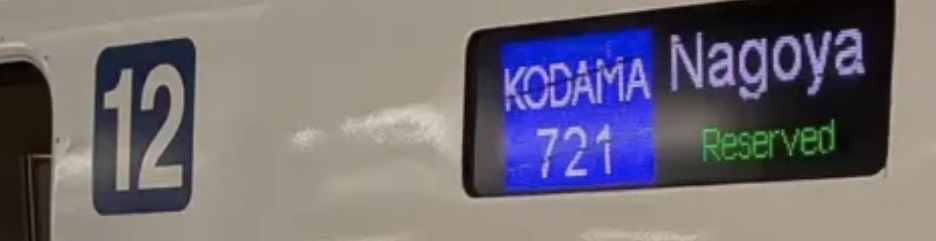
(This photo is car #12 of a Kodama (train
#721) to Nagoya. Yours should say KODAMA but the train # will be
different and the destination will be Shin-Osaka)
If you miss the Shinkansen that you bought your ticket for, you can get on the next Kodama こだま train, and ride in an unreserved section. Unreserved seats are at the front and/or the back of the train, a loudspeaker announcement will tell you which cars are unreserved. Note however that you might need to stand because they never know how many people will show up trying to ride "unreserved" for any given train.
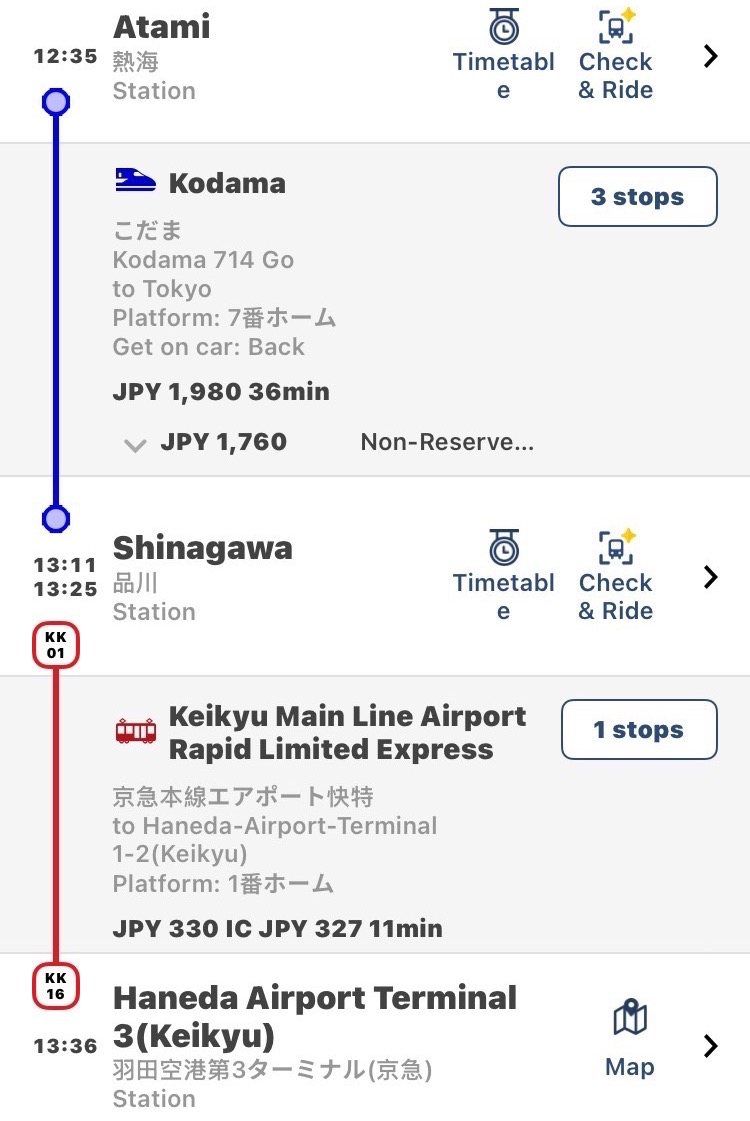
The times in this screenshot are an example. Allow yourself 35 minutes to get to Shinagawa station, 20 minutes to locate the Shinkansen ticket machine and buy your tickets, and 10 minutes to get to platform 24 for the Shinkansen.
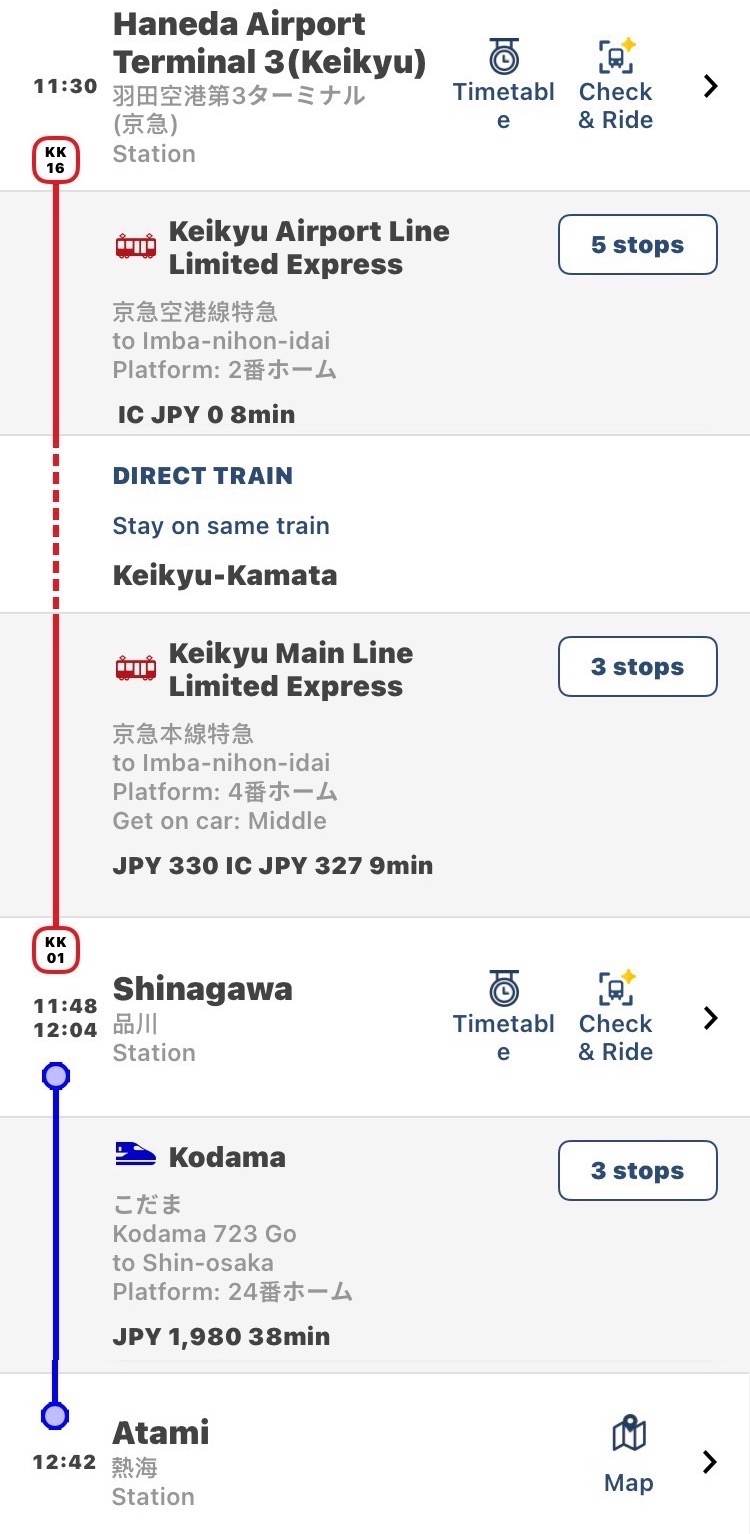
Once at Atami 熱海 station, go through the turnstiles, give it your Shinkamsen paper ticket(s) which it will keep, and tap the PASMO card (because you're about to ride local trains again).
Then go to platform 3 or 4 to get the next train towards Shizuoka 静岡, Shimada 島田, Hamamatsu 浜松, or Toyohashi 豊橋. All of those trains stop at your station which is Fuji 富士 station.
(You may have noticed that after Atami the Shinkansen stops at a "Shin-Fuji" station, but that station doesn't connect well with the trains going to Fujinomiya.)
At Fuji station go to platforms 1 and 2 for the JR Minobu line, and get on a train bound for Kofu 甲府 or Nishi-Fujinomiya 西富士宮.
The app does not tell a platform number, because the trains arrive and leave on two different platforms (this is an end-of-line stop, like Flushing Main Street where you sometimes have two (7) trains stopped at the same time).
Whatever train you get on, get off at Fujinomiya 富士宮. When the train stops at Fujinomiya the doors probably won't open until you press the button next to the door. Take the stairs or elevator, and use your PASMO card to get out (it charges you for the two local trains you just took).
Times in this screenshot are just an example:
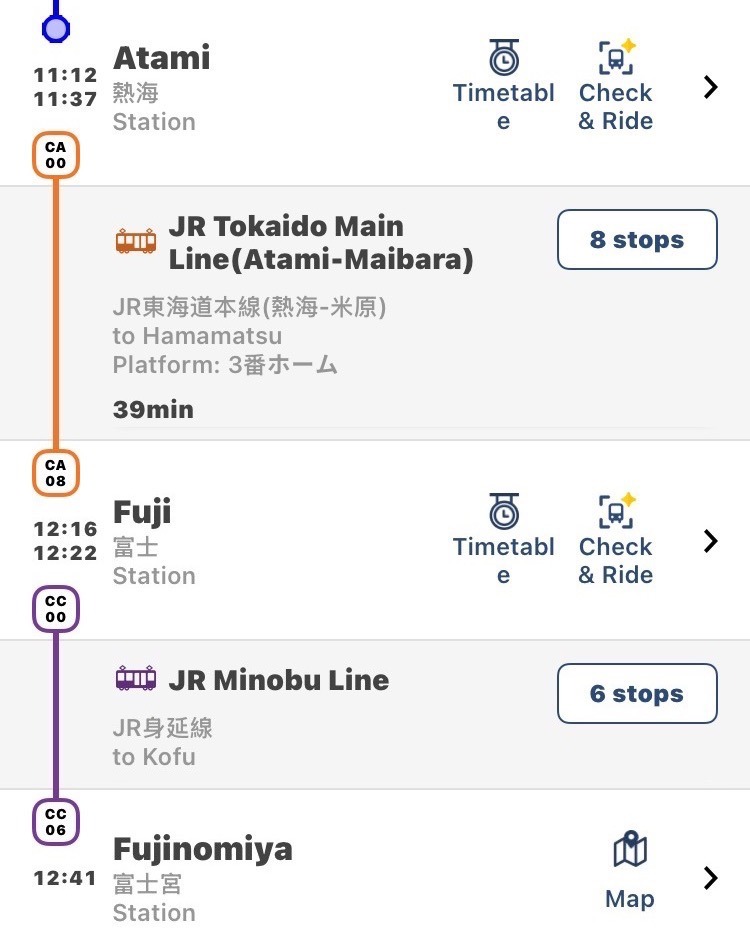
Fujinomiya to Haneda
The trip from Fujinomiya back to Atami (two trains, as described here) takes as much as 82 minutes, so allow yourself 1 hour and 35 minutes from when you board the first train until your Shinkansen train time. Trains from Fujinomiya in the direction you want, on Tuesday April 8th are at:
7:30, 7:39, 8:05, 8:18, 8:39,
9:02, 9:20, 9:48, 10:09, 10:23, 10:48,
11:19, 11:48, 12:08, 12:49,
13:22, 14:19, 14:49,
15:16, 15:49, 16:01, 16:23, 16:42,
17:02, 17:36, 18:00, 18:21, 18:37,
19:34. ...
The first train will be heading towards Fuji 富士 station (or possibly Shizuoka 静岡). You want to be heading in a southeast direction. This means that when you're on the train facing forwards, as you pull out of Fujinomiya station, Mount Fuji will be on your left.
When the train stops at Fujinomiya the doors probably won't open until you press the button next to the door. You might also need to press a button to get out.
At Fuji station go to platform 3 and get on a train to Atami 熱海 (not Numazu which goes the same direction but would require you to change trains to get all the way to Atami).
Times in this screenshot are just an example:
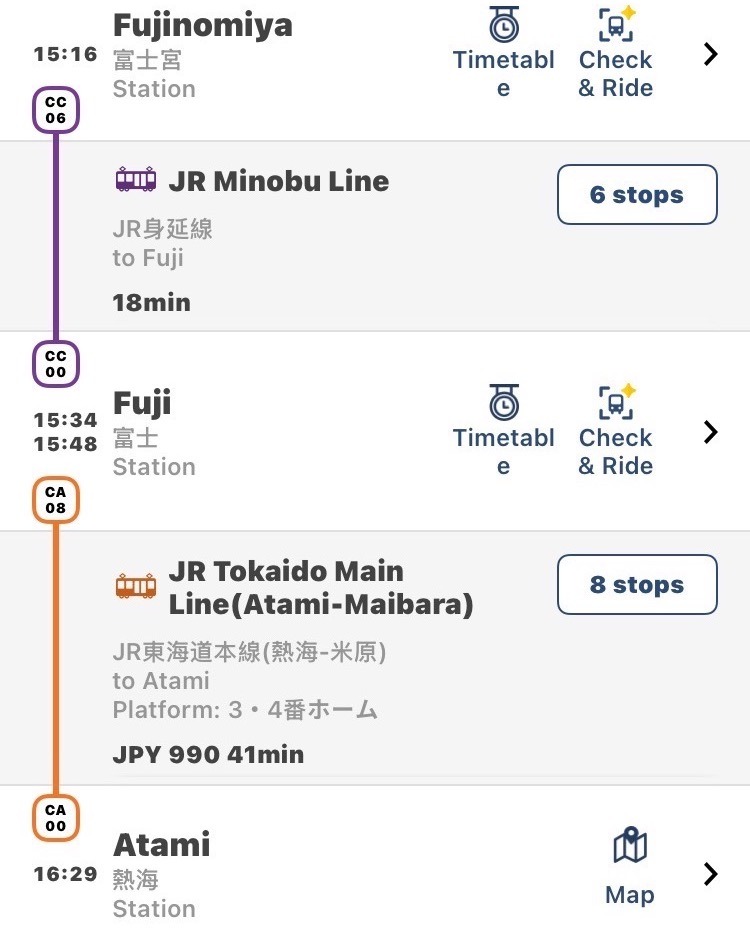
At Atami station find the Shinkansen turnstiles for platform 7. Use your Shinkansen ticket (or two tickets if that's what you have), tap your PASMO card, and hold onto the ticket(s).
The trains towards Tokyo will stop on platform 7, and the train's destination is Tokyo 東京 but you'll get off at Shinagawa 品川.
As before, make sure you're getting on a Kodama こだま train, and if you're on a later train than your ticket was purchased for, ride in an unreserved car.
(This time your KODAMA train will be
heading towards Tokyo)
When arriving at Shinagawa station, do not go up the escalators near where the front of the train stopped, or even the middle. Find the escalators that are near where the rear end of the train stopped.
(When we didn't do this, we had to then cross through an area that is considered to be outside the station, and the turnstile wouldn't let us re-enter for the Haneda airport train, we had to talk to an agent.)
Go to the Keikyu airport train (look for a big red line on the floor that says "Handea Airport" with airplane symbols). Wait on one of the blue "Haneda Airport" waiting lines and get on a Haneda Airport train.
Times in this screenshot are just an example:
Shinkansen Vending Machines
Look for a machine like this, probably marked with a sign that says "Shinkansen tickets" (or show this picture to someone):
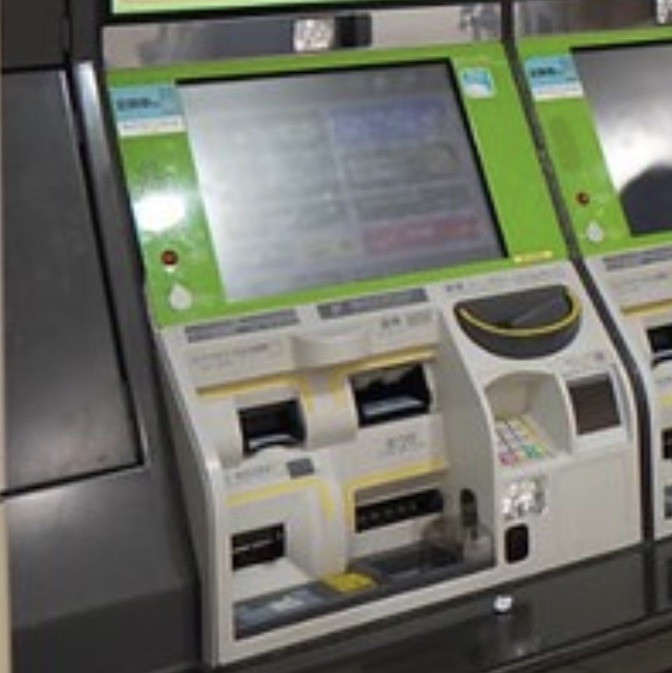
There are also machines that are blue instead of green, and they work the same way — but the ones we've used at Shinagawa were green.
At the top of the screen choose ENGLISH:

Choose to purchase a reserved seat ticket:
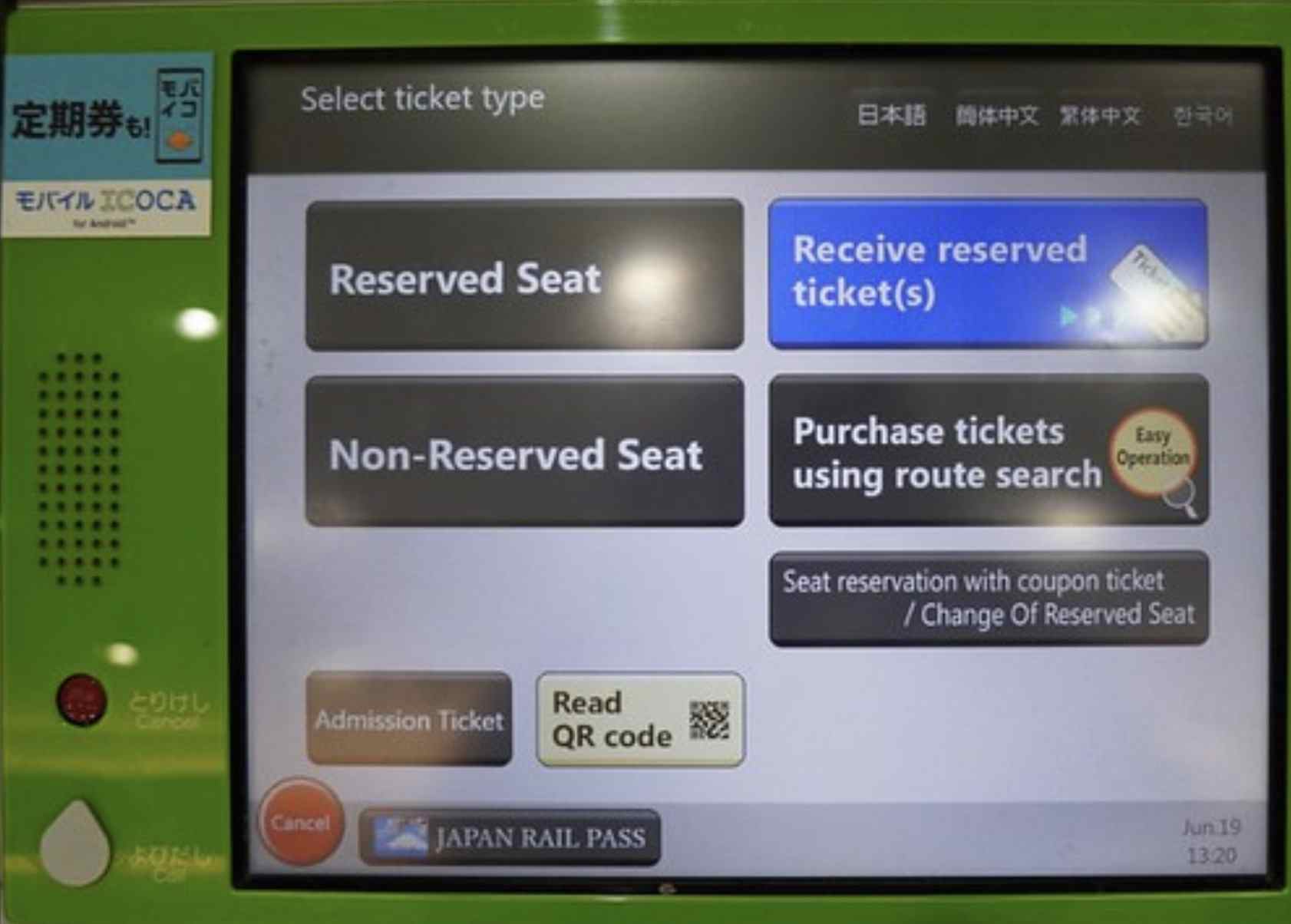
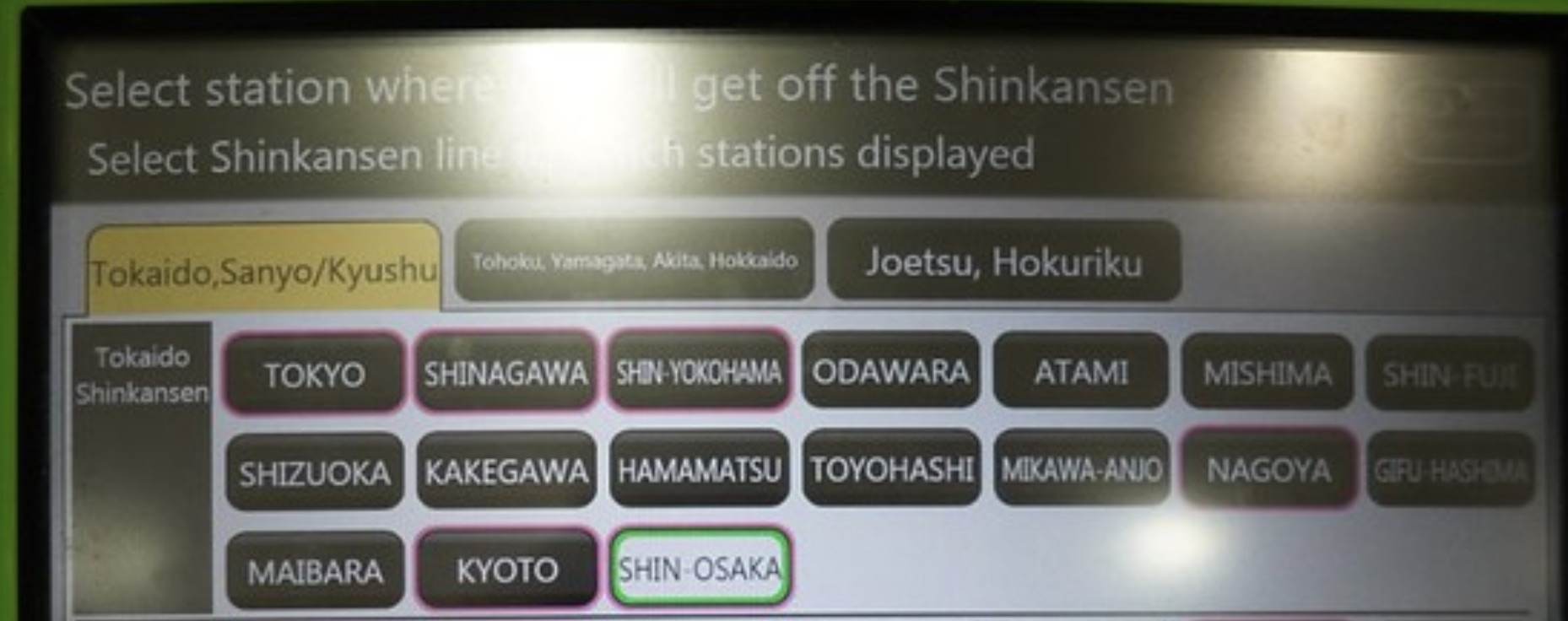
There are steps to choose the number of adults/children/etc., departure and arrival stations, the date and time, and seat selection.
Shinagawa and Atami stations are both on the Tokaido line, notice in this picture the stations are grouped by geographic region, and the region you want is Tokaido,Sanyo/Kyushu.
When asked if you want a "base fare" or "basic fare" ticket you must say yes, otherwise the ticket you end up with is just a bullet train upgrade (for Japan Rail Pass holders).
The machine will probably ask if you want to purchase something involving "return". This means getting ticket(s) for the return trip, i.e. the second half of a round trip:
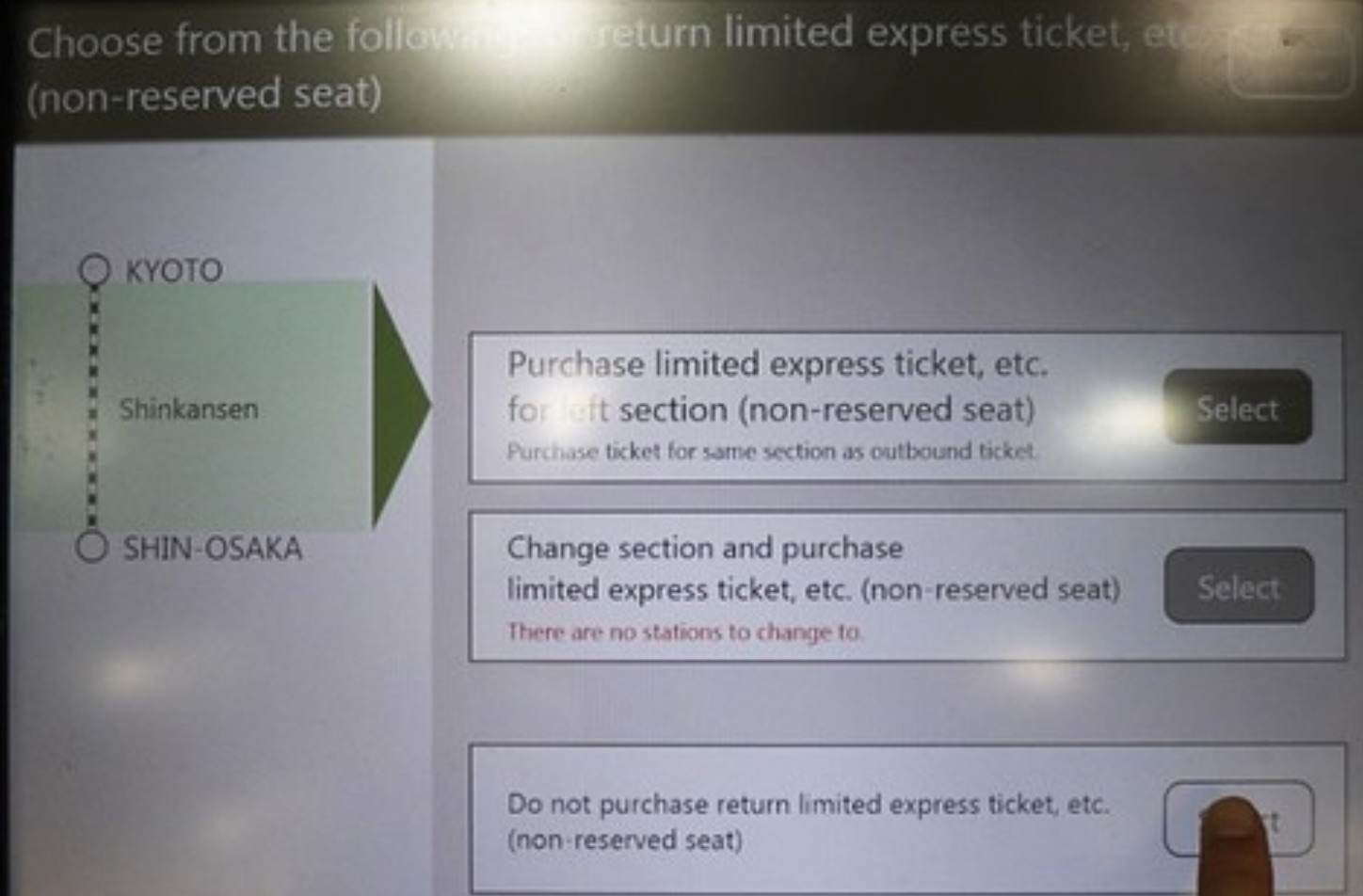
In the above picture the choices are:
- Return the same way you came ("left section" means the section of train line shown to the left, i.e. Kyoto back to Shin-Osaka)
- "Change the section" means return to/from a different station. "There are no sections to change to" in red means that there are no other starting and ending stations available. In some cases two stations are interchangable, for example you'll probably be able to return to Tokyo instead of Shinagawa for the same price (basic fare + Shinkansen reserved) so I think that will be offered as an option.
- "Do not purchase return..." means you just want a one-way ticket.
Some machines will instead give the more obvious choices of "One-way" vs. "Round-trip" and the example I found was just those two options.
I chose one-way ("Do not purchase..." in the picture) just to keep it simple: it's a bit hard to tell these tickets apart, so I wanted to purchase the first ticket, put it in my wallet, then purchase the return trip and keep that in my bag for later.
If you choose to return the same way (first option of the three above) or "Round-trip" then you'll be prompted for date and time and seat selection; the final confirmation screen will show two trips; and the payment will be approximately twice (per person, which should be about ¥8,340, which is 2× ¥1,980 in basic fares plus ¥2,290 Friday and ¥2,090 Tuesday).
There is a confirmation screen showing all the choices you made on one screen:
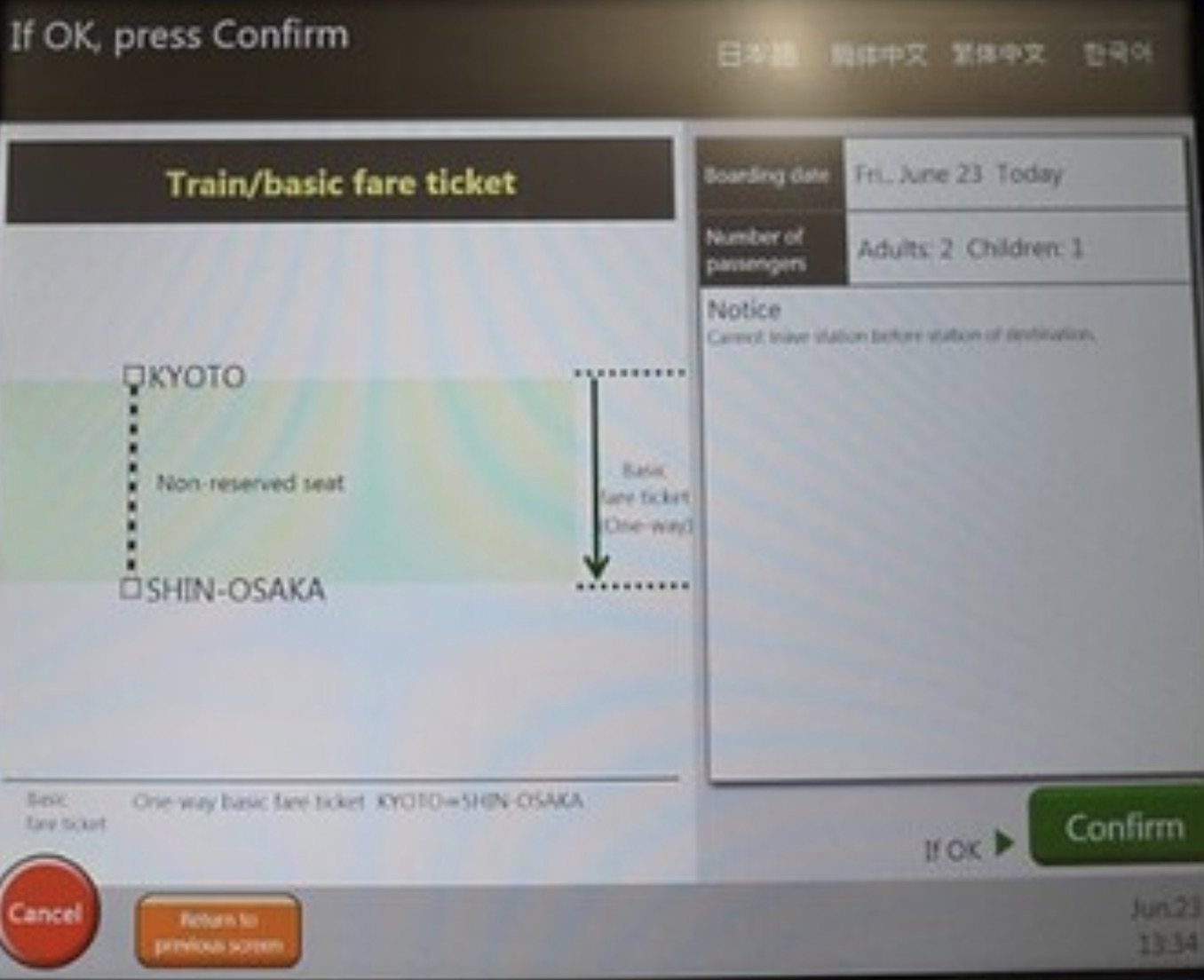
After this screen you'll be asked how you want to pay. I believe this is the first time it will show how much you're spending. I expect it will be ¥4,270 or ¥4,070 (one way) or ¥8,340 (round trip) per person.
end of article, notes follow
Notes
- All stations have toilets inside the area where you change trains and wait for trains. They are easy to find in the smaller stations.
- Shinagawa has a lot of places to get food or snacks. Atami and Fuji appear (in Apple maps) to have just a couple small kiosks.
note 1: When Rick and I bought tickets from a machine, we got both fares in a single printed ticket, but when buying from an agent at a window we each got two tickets. Using a machine I think you always get a single ticket, but see note 2.
note 2: If you accidentally purchase only the upgrade fare (by telling the machine that you don't want to purchase the base/basic fare ticket), you can go back to the machine and get a ticket for a normal train (not Shinkansen) between the same two stations (or nearest equivalents, e.g.: Yokohama and Shin-Yokohama, or Fuji and Shin-Fuji), and use the two tickets to ride Shinkansen.
"equivalent" stations (note 3): Shinkansen required higher-quality tracks on routes that don't bend as much, so many Shin- ("new") stations were built near existing trunk railroad line (kansen) stations. To accommodate existing established travel patterns and meet existing demand, these new sttions are as close as possible to the old stations (which still exist for the many local and express non-bullet trains). For example Shin-Yokohama station is near Yokohama station. This inspired the two layer fare system (note 4), in which the old and new stations are considered the same for pricing and purchasing a base/basic fare ticket, which is used the normal way when riding on normal trains between the old stations. In many cases the Shinkansen line runs through the old stations so there is no distinction except to go through special turnstiles. Some other pairs of stations are considered "equivalent", such as Shinagawa and Tokyo, which are only a few minutes apart on the Shinkansen.
two-layer fare system (note 4): Before Shinkansen there were many popular express trains achieving modest speeds like 80 MPH. Japan Rail decided to allow people to purchase tickets for these existing trains, then "upgrade" their trip to the bullet train by purchasing an additional ticket. The decision to upgrade can be made later, offering customers greater flexibility. To ride a Shinkansen you have to have both tickets: one to go from A to B on any train, and another specifically for making that trip on a Shinkansen. Most people who already know they want Shinkansen will use a machine and get a single ticket attesting to both fares.
Fun Facts
- The Fujinomiya train is very short (count the cars!) so it can run more often. In truly rural areas it gets even smaller.
This page was written in the "embarrassingly readable" markup language RHTF, and was last updated on 2026 Feb 12.
 s.30
s.30