Gearing Ideas and Notes
This page discusses some ideas related to gearing mechanisms that came out of my other projects (primarily the orreries) but are only remotely or tangentially related (no pun intended) to them.
Contents
Hailfire Droid Wheel as Ring Gear
Related:
Rotational Maths for Orrery Design
Traditional Mounting
In the early days of LEGO Technic, the one and only way to set up gear trains was like this:
|
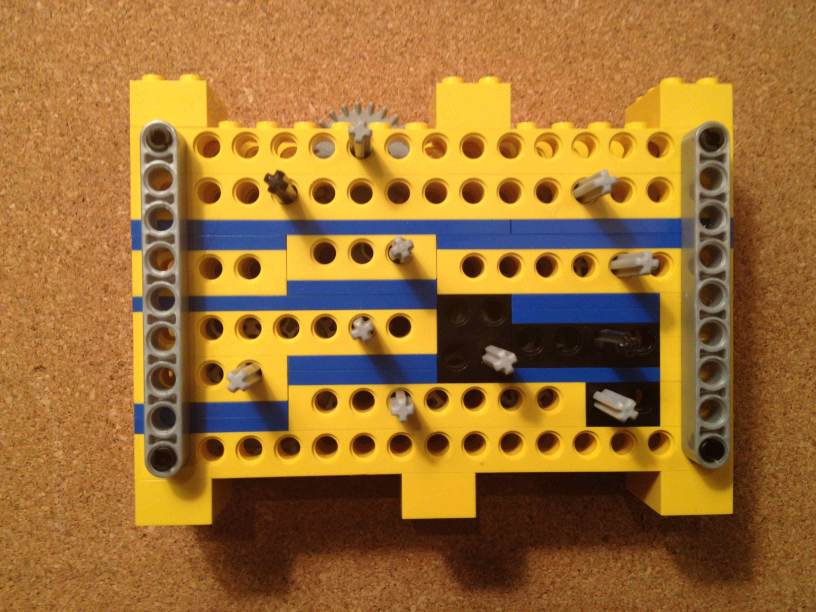
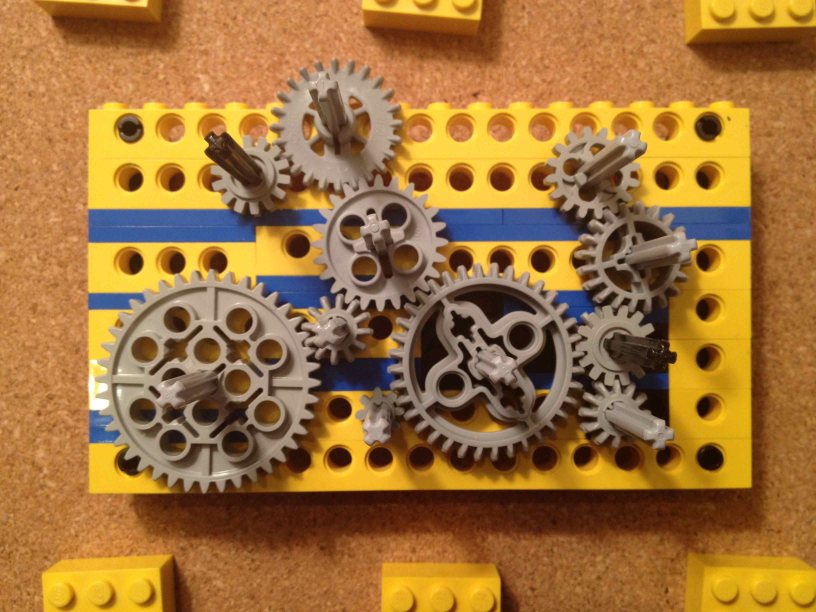
Axle and Cross-Block Mounting
The use of axles and cross-blocks (such as part 6536) allows for much more flexibility in how you position your gears.
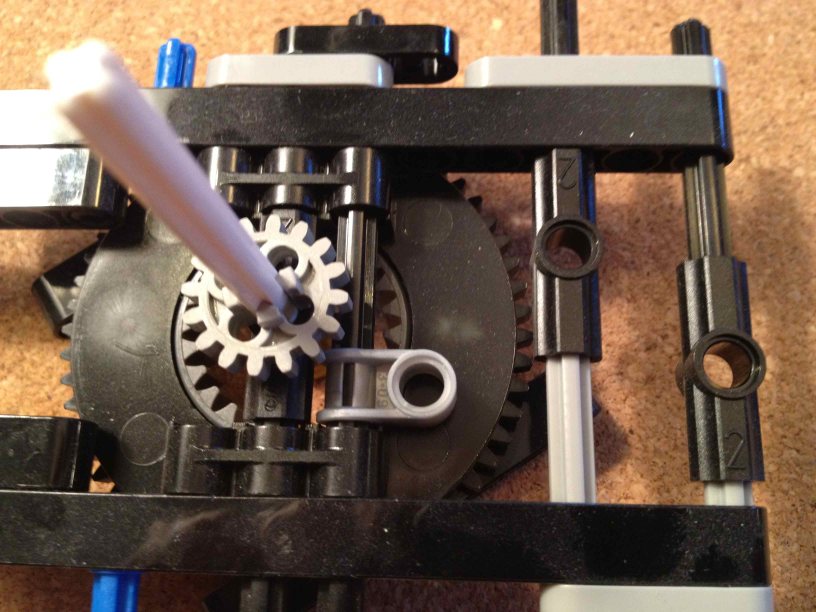
axles with cross-blocks
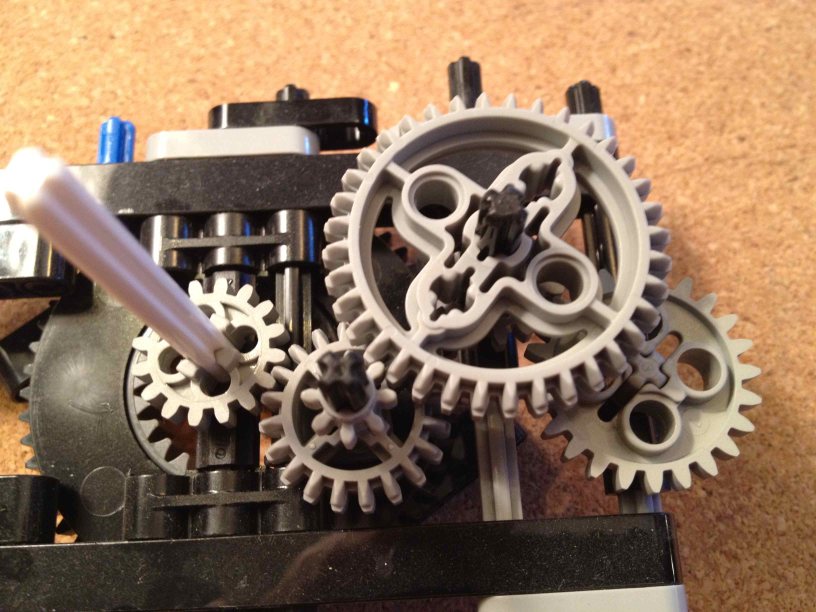
the same, with gears added
The axles and cross-blocks and other little connectors allow for far more variety in how each hole is positioned. This is similar to the arrangement of Technic bricks and plates shown above, except that you can use arbitrary spacing along one axis (the vertical direction in these photos).
This technique allows for the creation of a variety of gearing ratios in a standardized geartrain "module". For example, see my Stacked Turntable Module (method 3) Building Instructions
Hailfire Droid Wheel as Ring Gear
The large wheel in the picture was only ever used in one set, 4481. It is a ring gear with 168 teeth racing inward. This is exactly three times the 56 teeth on the outside of the Technic Turntable (part 48452cx1), which means you can just fit three across inside the ring. I looked for another way to construct a concentric planetary gear mechanism, and here is the result:
|
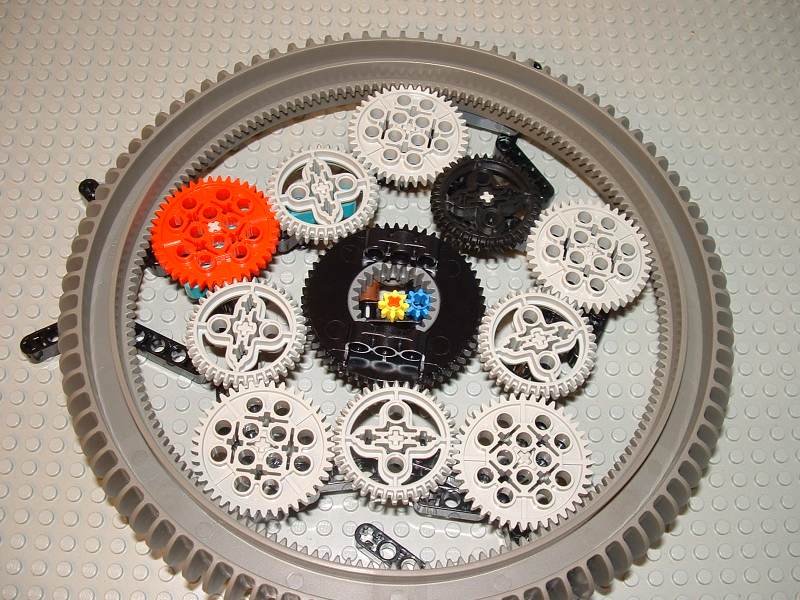
The turntable in the center serves as the sun gear; the z36 and z40 gears are the planets (the planet carrier is hidden below the gears) and the Hailfire Droid wheel is the ring gear.
All pairs that should be meshed are just right, except two: the red gear is just a little bit shy of the outer ring, and the two black ones (the inner one being the turntable) are not meshing with each other at all. The rest move really well and really smoothly. Since 4 out of 5 is all it takes to keep the assembly centered and stable, the construction works as intended.
The z36 and z40 gears are all held together by a symmetrical arrangement of parts 6629 and 32009:
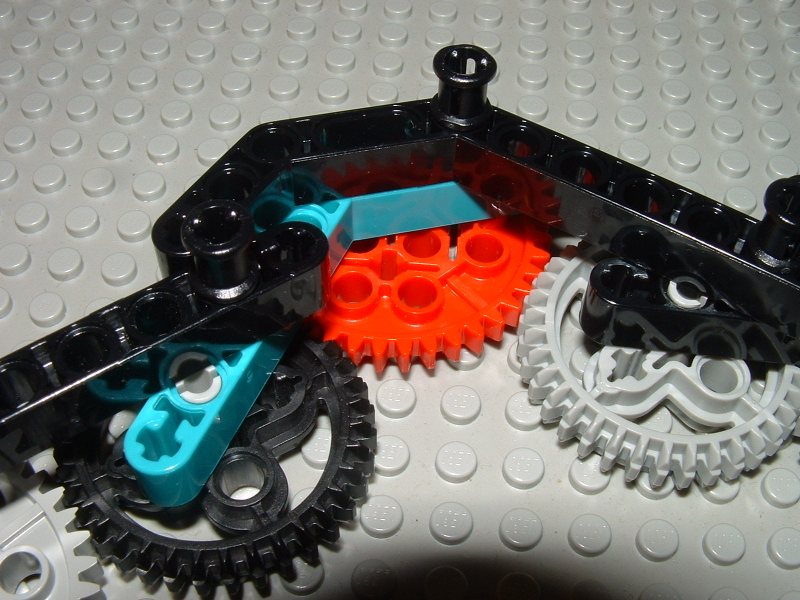
detail
Inside the turntable is a normal planetary gear setup — here the sun and planet are yellow and blue z8's, and the turntable serves as ring gear.
For a smaller (perhaps more practical) planetary gear solution there is the relatively newer part 64712 used in some of the "Power Miners" sets (8059, 8959, 8960, etc.) and a couple Ninjago sets like 2518 "Nuckal’s ATV". There are 48 inward-facing teeth around the inside of a wheel with ribs and spikes around the outside.
Inside-Out Differential
Here is a way to construct a differential without a differential housing:
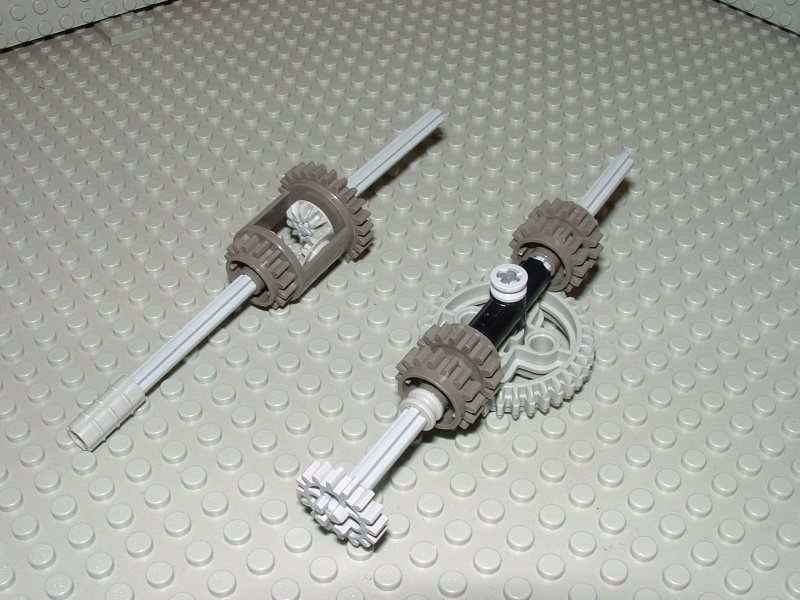
Normal and Inside-Out Differentials
In a normal differential (shown on the left) the rotation of the housing (dark gray) is the average of the rotations of the two gray axles. As used in a vehicle, the drive goes into the housing, and the wheels are driven by the two axles.
In the alternate differential (on the right) the two gray axles are connected (so they are the same axle), and the two pairs of dark grey gears move independently of the axle. The motion of the central axle is the average of the rotations of the two pairs of dark gears. In the vehicle application, the drive power would go into the central axle, and each wheel would be driven by one of the dark gray gears.
The little tiny teeth on the dark gray gears (not present on the differential housing) allowed me to make this somewhat whimsical orrery depicting a single planet with a moon, orbiting a triple star system:
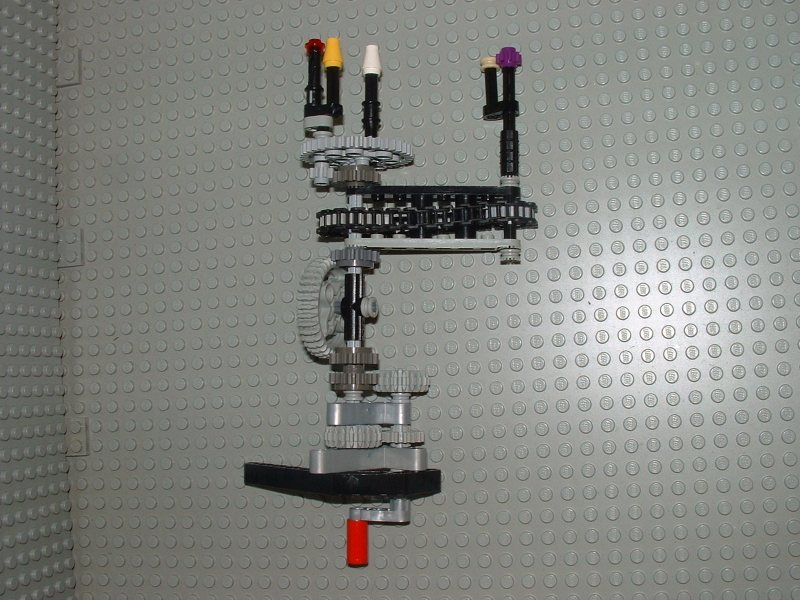
Orrery Based on the Inside-Out Differential
Here is what it looked like after I added a stand:
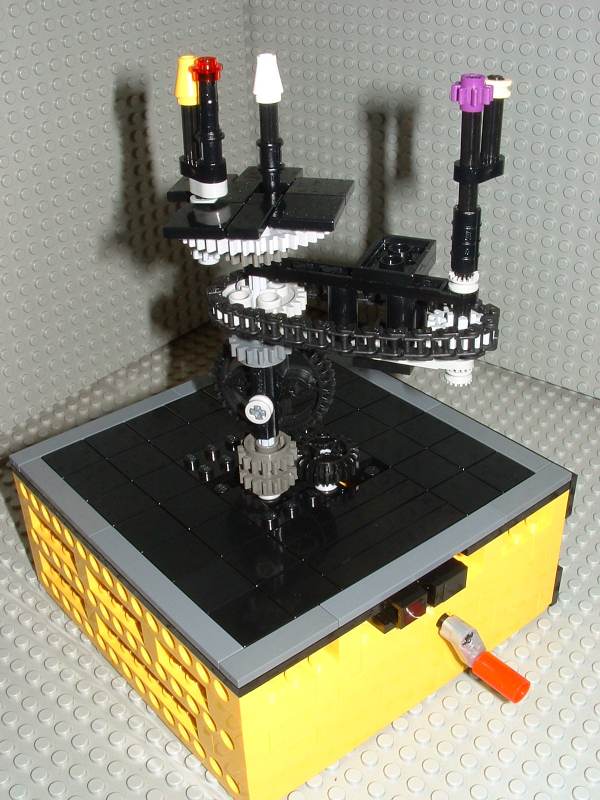
Complete Version
Links
Forest Hills Robotics League, building tips (date unknown)
Technic Bricks blog, Details about the new Mini Turntable, 2011 Oct 20
Technic Bricks blog, Planetary gear sets, 2009 Feb 14
The graph paper in my newer photos is ruled at a specing of 1 LSS, which is about 7.99 mm.
This site is not affiliated with the LEGO® group of companies.
LEGO®, Duplo®, QUATRO®, DACTA®, MINDSTORMS®, Constructopedia®, Robotics Invention System® and Lego Technic®, etc. are trademarks or registered trademarks of LEGO Group. LEGO Group does not sponsor, authorize or endorse this site.
All other trademarks, service marks, and copyrights are property of their respective owners.
If you want to visit the official LEGO® site, click here
Parts images are from LUGNET. On this page they explicitly give permission to link to the images:
Note: you may link (as in, Yes, it's OK) directly to these parts
images from an off-site web page.
This page was written in the "embarrassingly readable" markup language RHTF, and was last updated on 2012 Dec 24.
 s.27
s.27