Internal Angle
Robert P. Munafo, 2012 Apr 16.
An internal angle is a rational fraction, such as 13/21, used to name a secondary continental mu-atom.
By extension, an internal angle is a rational fraction used to name any child of a given mu-atom.
The term internal argument is sometimes used as a synonym.
The fractions in the R2-names in the figure below are internal angles; there is a table in the secondary continental mu-atom article giving a lot more.
For any two relatively prime integers N and M, with N less than M, there is a mu-atom of period M located at "internal angle" N/M on the main cardioid. The internal angles start at 0, at the cusp, and increase counterclockwise.
Examples:
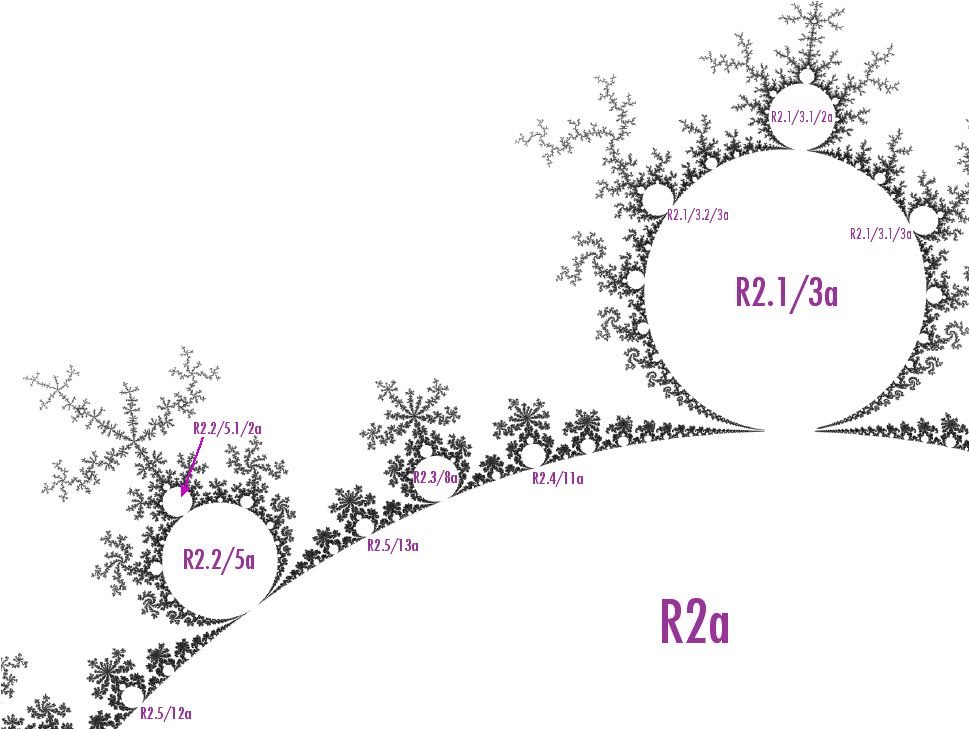
various mu-atoms
Several mu-atoms are labeled in this figure by their R2-names. Those which are secondary continental mu-atoms have a single rational fraction in their R2-names. This fraction is the mu-atom's internal angle. For example: the internal angle of R2.2/5a is 2/5, the internal angle of R2.4/11a is 4/11, and the internal angle of R2.1/3a is 1/3.
A formula giving the position of the bond point between R2a and any secondary continental mu-atom R2.N/Ma is given in the secondary continental mu-atom article.
You can determine the internal angle of a non-seed mu-atom using Farey addition on the internal angles of its two larger neighbors. If you don't know the internal angles of the larger neighbors, apply the rule recursively.
You can also "read" the internal angle off the mu-atom's filaments by counting branches counterclockwise from the smallest branch to the mu-atom. For example, look at R2F(5/8B). The main branch point has 8 branches — that's the denominator of the internal angle. The "shortest" filament points down from the center, and the inward-leading branch extends to the upper-right (and has the rest of the Mandelbrot set attached to it). Count counterclockwise from the inward branch to the shortest branch, and you get 5 — that's the numerator.
In general, if you know the internal angle, but don't know where the mu-atom is, you can locate the mu-atom by determining the internal angles of its two larger neighbors, and their larger neighbors, and so on. The process is described in detail under the heading binary search for internal angle.
See also clockwise, Farey addition, inner neighbor, internal address.
revisions: 20100911 oldest on record; 20120416 add illustration
From the Mandelbrot Set Glossary and Encyclopedia, by Robert Munafo, (c) 1987-2024.
Mu-ency main page — index — recent changes — DEMZ
This page was written in the "embarrassingly readable" markup language RHTF, and was last updated on 2012 Apr 17.
 s.27
s.27