Secondary Continental Mu-Atom
Robert P. Munafo, 2023 Jul 7.
The secondary continental mu-atoms are the mu-atoms that touch the main cardioid. (See also secondary and continental). Colloquial names include ball, bud, limb, satellite most of which more generally refer to any non-cardioid mu-atom.
These mu-atoms are usually the first pattern that people notice when they see the Mandelbrot set for the first time. As a result, it is common to discover the patterns within these mu-atoms and develop that knowledge into an Analytical Naming System.
Contents
Precise Location Formulas
The position of the bond point between R2a and any secondary continental mu-atom R2.N/Ma is:
a2 - b2 + 1/4 + 2ab i
where
a = sin(2 pi N / M) / 2
b = (1 - cos(2 pi N / M)) / 2
and N/M is the mu-atom's internal angle. Expressed as a complex number, the bond point is located at:
B = lambda (2-lambda) / 4
where
lambda = e2 pi N/M
is a point on the unit circle. The derivative of B with respect to lambda is:
dB = 1/2 (1 - lambda) dlambda
the radius of the mu-atom R2.N/Ma is the absolute value of this divided by M2, which is equivalent to this approximation given by John Milnor:
radius ≅ sin(2π N/M) / M2
The position of R2.N/Ma's nucleus is approximately
B - i dB / M2
but this is only precise in the case of R2.1/2a. For all others, it can be used as an initial value for the Newton-Raphson method, since the nucleus is a solution to the equation LM=0 where LM is the Mth Lemniscate.
These formulas can be generalized; see mu-atom size formulas.
Examples
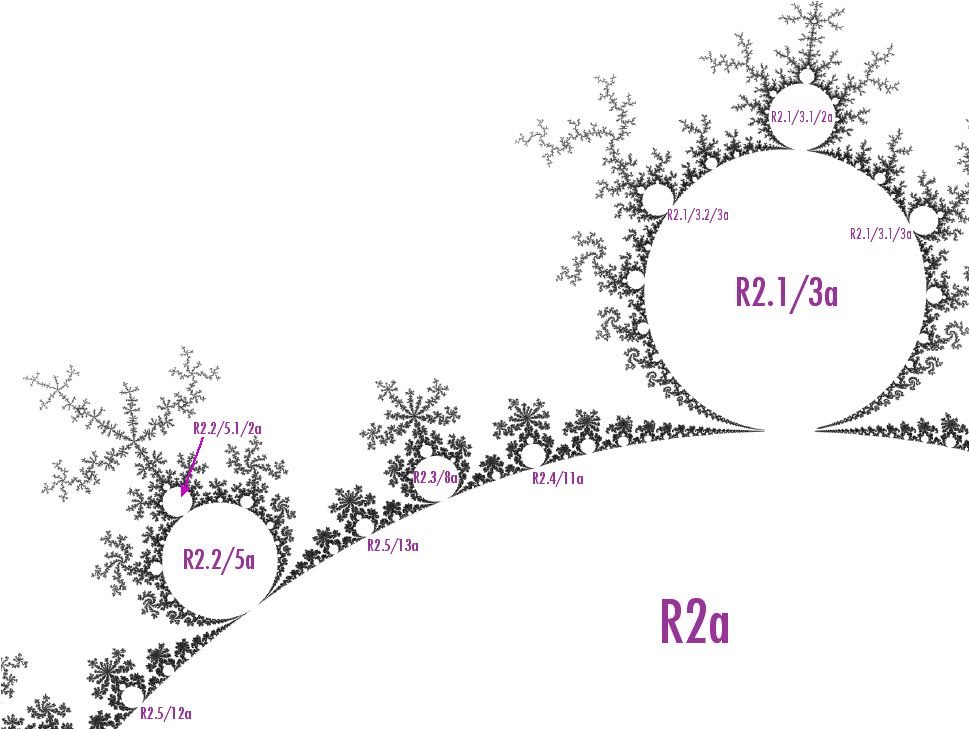
A part of the continent with some secondary and tertiary mu-atoms labeled
In the figure above, the following mu-atoms are secondary continental: R2.5/12a, R2.2/5a, R2.5/13a, R2.3/8a, R2.4/11a, and R2.1/3a.
The mu-atom R2a is the continent seed or "main cardioid"; the other labeled mu-atoms (such as R2.1/3.1/2a) are tertiary continental mu-atoms.
Full Listing up to Period 16
The following table lists all secondary continental mu-atoms with denominators less than or equal to 16. It is useful for finding mu-atoms given their R2 names.
For example, suppose you want to locate R2.3/8a. Its internal angle is 3/8; using the table, you find that the internal angles of its larger neighbors are 1/3 and 2/5. This means that R2.3/8a is located between R2.1/3a and R2.2/5a. If you do not know where these mu-atoms are located, you could use the table again to locate their larger neighbors.
Internal CW Larger CCW larger Internal CW Larger CCW larger Angle Neighbor Neighbor Angle Neighbor Neighbor 1/2 --- --- 5/9 1/2 4/7 1/3 --- 1/2 5/11 4/9 1/2 1/4 --- 1/3 5/12 2/5 3/7 1/5 --- 1/4 5/13 3/8 2/5 1/6 --- 1/5 5/14 1/3 4/11 1/7 --- 1/6 5/16 4/13 1/3 1/8 --- 1/7 6/7 5/6 --- 1/9 --- 1/8 6/11 1/2 5/9 1/10 --- 1/9 6/13 5/11 1/2 1/11 --- 1/10 7/8 6/7 --- 1/12 --- 1/11 7/9 3/4 4/5 1/13 --- 1/12 7/10 2/3 5/7 1/14 --- 1/13 7/11 5/8 2/3 1/15 --- 1/14 7/12 4/7 3/5 1/16 --- 1/15 7/13 1/2 6/11 2/3 1/2 --- 7/15 6/13 1/2 2/5 1/3 1/2 7/16 3/7 4/9 2/7 1/4 1/3 8/9 7/8 --- 2/9 1/5 1/4 8/11 5/7 3/4 2/11 1/6 1/5 8/13 3/5 5/8 2/13 1/7 1/6 8/15 1/2 7/13 2/15 1/8 1/7 9/10 8/9 --- 3/4 2/3 --- 9/11 4/5 5/6 3/5 1/2 2/3 9/13 2/3 7/10 3/7 2/5 1/2 9/14 7/11 2/3 3/8 1/3 2/5 9/16 5/9 4/7 3/10 2/7 1/3 10/11 9/10 --- 3/11 1/4 2/7 10/13 3/4 7/9 3/13 2/9 1/4 11/12 10/11 --- 3/14 1/5 2/9 11/13 5/6 6/7 3/16 2/11 1/5 11/14 7/9 4/5 4/5 3/4 --- 11/15 8/11 3/4 4/7 1/2 3/5 11/16 2/3 9/13 4/9 3/7 1/2 12/13 11/12 --- 4/11 1/3 3/8 13/14 12/13 --- 4/13 3/10 1/3 13/15 6/7 7/8 4/15 1/4 3/11 13/16 4/5 9/11 5/6 4/5 --- 14/15 13/14 --- 5/7 2/3 3/4 15/16 14/15 --- 5/8 3/5 2/3The use of "secondary" here is not universal. For example, Prof. Devaney refers to these mu-atoms as primary bulbs. See also fixed-point cardioid.
revisions: 20030927 oldest on record; 20120416 add illustration and example of using the table; 20230707 more synonyms
From the Mandelbrot Set Glossary and Encyclopedia, by Robert Munafo, (c) 1987-2024.
Mu-ency main page — index — recent changes — DEMZ
This page was written in the "embarrassingly readable" markup language RHTF, and was last updated on 2023 Jul 08.
 s.27
s.27