R2F(1/2B1)S
Robert P. Munafo, 2023 Aug 5.
R2F(1/2B1)S is the largest island mu-molecule in the Mandelbrot Set. It is located on the real axis with its cusp at precisely -1.75.
There are many names for this island, ranging from very technical to colloquial. Romera, Pastor, and Montoya refer to it as the "CLR" minibrot because the three iterates in the limit cycle for its nucleus follow the pattern: Critical, Left, Right (because the 2nd iterate is negative, i.e. to the left or the origin, and the 3rd iterate is positive, i.e. to the right).
| R2-Name: | R2F(1/2B1)S |
| Abbrev: | RF(2)S |
| Colloq.: | Period-3 minibrot, largest island |
| Coords: | center = -1.765+0i, size = 0.06 |
The nucleus of R2F(1/2B1)S is given precisely by one of the solutions to the equation Z3 = 0, where Z3 is the 3rd lemniscate. It is precisely:
(√23/(6 √3)-25/54)^(1/3) + 1/(9 (√23/(6 √3)-25/54)(1/3)) - 2/3
which works out to -1.754877667430458... + 0i. This value was first published in a 1963 paper (PM2) by Pekka Myrberg (who was using the recurrence z → z2-c, and gave the value as 1.7548776662):
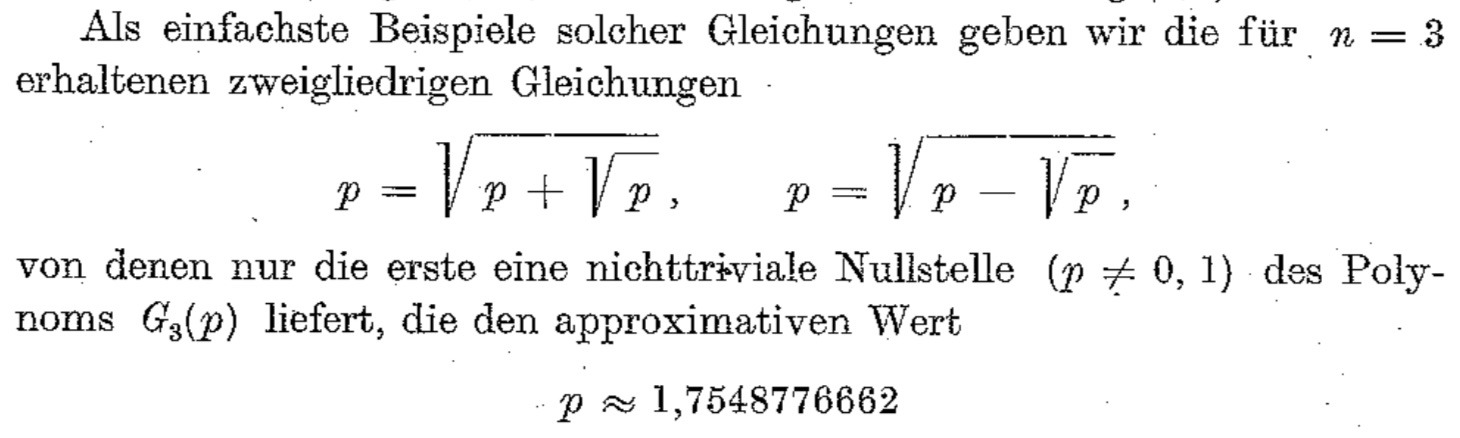
From Myrberg's 1963 paper
s.jpg "-1.76733 +0.00002 i 0.05") -1.76733 +0.00002 i @ 0.05 |
", C _ ./
'", . .` :c(
`., '.\r-,-` . -~
``\ -, -., ^-"@bbF'_,~ ..-
~_- '\, `-,.mL@F@La\ . a`
''-, `_ \ v -.$F ^@` /,: /_,._
'-_ _ `\bade\b)@*---"""(*b.mm@b~_ .
'^. 'c -, \TC@^""` `"`_dF`_.--'
D ~_a , :. , _`m@""` 'Ye_b\,
'. ., --]@)_cmdeL.'-@F` \FY___-
`e `.,/-,"@^*""""\e:F B :%*L,
, ,'-. - - -m)$@^ 'Y :F"
.-(':ddddaddm@d@^^` R2F(1/2B1)Sa -m^------ A
~ ''/''/',^d@Y(b, .a Y_r
_" _/`\;"$@-_,...a/T, '(L^^
.-` -` .,:)Y*F@bFF\-$bc .C7----
.."^`` :^ ` ^a@@L, ,r(@r-
._-` :c .-`-^:@`.,, ._-'@;-`--__
.,^ ' ^a@@@FTbv__, ___a_m"bmd@,- '
.~ _-` `/'"`-~@C 'b''(`' '*"'`
$", :/` __--@bmcmbY)- ~ '\
a/` .~ -` '.;C@@e-`-, '~,
_-` ' .m/@\`^^ ' '.,
` ..' `~ . 'c/
.` " '\
-1.76733 + 0.00002i @ +0.05, Nmax: 1000
R2F(1/2B1)S |
To the left of B: Location of figure 2 in the embedded Julia sets article.
Below C: Location of figure 3 in the embedded Julia sets article.
Below D: the island's tip, at approximately -1.79032749199934. (for a close-up image, see the Misiurewicz point article)
Like all islands, R2F(1/2B1)S is surrounded by a large collection of filaments that resemble the filament in which the island is contained. In this case, the filaments are straight. The shape of the filaments (long and straight with few side branches) allows for a minimum of clutter in both Distance Estimator and Dwell views, and also has the effect of reducing the Dwell Limit that is necessary for viewing various types of features.
Perhaps the most interesting features found near islands are the embedded Julia sets. Because R2F(1/2B1)S is the largest island, it has the largest embedded Julia Sets, and is thus the best place to explore them (particularly when zooming is limited by available computational accuracy).
Because R2F(1/2B1)S is on the real axis, it has mirror symmetry. Most islands do not. It is not just a scaled-down copy of R2; it has a trapezoid-shaped distortion that makes its eastward features larger and westward features smaller than their counterparts on R2. For example, R2F(1/2B1)SF(1/4B1)S is larger than R2F(1/2B1)S.1/2F(1/2B1)S, but R2F(1/4B1)S is smaller than R2.1/2F(1/2B1)S. See Mu-Molecule Metrics for further explanation of mu-molecule distortions.
The largest island that is a part of R2F(1/2B1)S's mu-unit is R2F(1/2B1)SF(1/2B1)S.
[1] See the footnote in the R2.1/3a entry for the Maxima code that gives the precise formula.
revisions: 20080228 oldest on record; 20230322 add paragraph on alternate names e.g. "CLR minibrot" and description of tip referencing Misiurewicz point article; 20230805 Myrberg's result
From the Mandelbrot Set Glossary and Encyclopedia, by Robert Munafo, (c) 1987-2025.
Mu-ency main page — index — recent changes — DEMZ
This page was written in the "embarrassingly readable" markup language RHTF, and was last updated on 2025 Mar 21.
 s.30
s.30